
Supporting the climate transition

1 August 2022
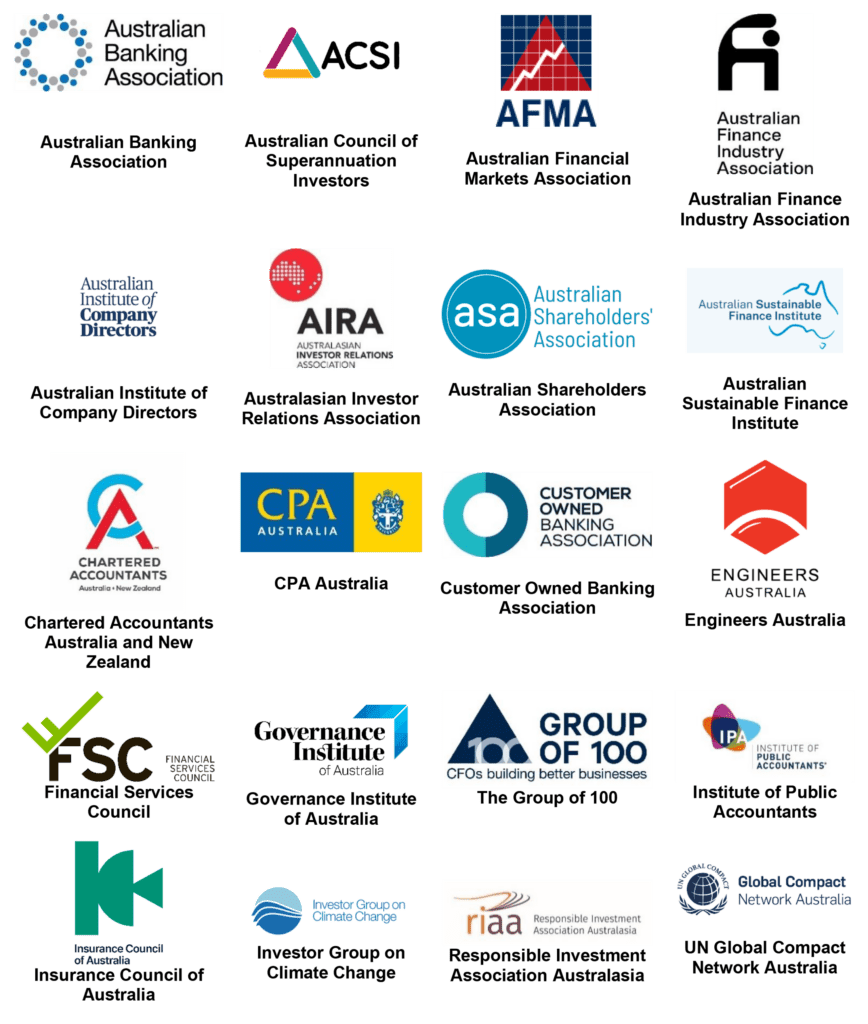
Twenty of Australia’s most influential business and finance peak bodies have come to an unprecedented consensus on the need for sustainability reporting including action on climate risk through a new reporting regime that aims to set a global baseline.
The group has welcomed the International Sustainability Standards Board (ISSB) draft sustainability standards in a joint submission which collectively represents the voice of 20 peak professional, industry and investor bodies in Australia who came together to prepare the joint response to the two exposure drafts.
The peak bodies together represent more than 400 companies, approximately 300 investors with US$33 trillion assets under management, and 500,000 business and finance professionals.
The group considers clear, transparent, comprehensive and comparable disclosure of sustainability-related information to be part of the foundation of a well-functioning global financial system.
The group supports a global approach to the development of sustainability disclosure standards and for the ISSB to be the global body to issue these standards.
The overarching goal should be a globally consistent, comparable, reliable, and verifiable corporate reporting system to provide all stakeholders with a clear and accurate picture of an organisation’s ability to create sustainable value over time.
It is critical that the ISSB and other jurisdictions developing sustainability standards take a coordinated approach to avoid regulatory and standard setting fragmentation by aligning key definitions, concepts, terminologies, and metrics on which disclosure requirements are built.
Collaboration and coordination between sustainability disclosure initiatives and financial accounting standard-setting is important. The ISSB is best placed to achieve this given its connection to the International Accounting Standards Board (IASB).
Climate represents a first order risk to the Australian economy, the financial system and investors. The group supports the Paris Agreement and its objective to take into account the needs of a just transition while achieving a net zero emissions economy and resilient Australia.
To avoid large-scale financial risks from a disorderly transition to net zero emissions and the physical impacts of climate change, there must be clear and comparable disclosure of sustainability-related and in particular climate related information.
The peak bodies each look forward to working with the Australian Government and key national and international stakeholders as the climate change reporting regime is finalised and phased in.
Latest news
ABA News
Statement from Way Forward re Cyber Incident
Read more
9 September 2026
Click here to read the statement from Way Forward.
Media Releases
Independent review of Banking Code kicks-off
Read more
4 September 2026
The ABA has today announced that former ASIC Deputy Chair Peter Kell will undertake the five yearly independent review of the Banking Code of Practice, the rule book that sets standards of service for customers. The Code sets out consumer protections and safeguards that are in addition to the law for individuals, small business customers… Read more »
Media Releases
Banks welcome designation of Armaguard within Cash Distribution Framework
Read more
3 September 2026
ABA welcomes today’s move by the Reserve Bank of Australia to designate Armaguard under the recently legislated Cash Distribution Framework Act. ABA CEO Simon Birmingham said this was an important step in providing ongoing stability to the distribution and availability of cash across the economy. “The Cash Distribution Framework is an important piece of regulatory… Read more »