
1 October 2026
E&OE
TV Interview
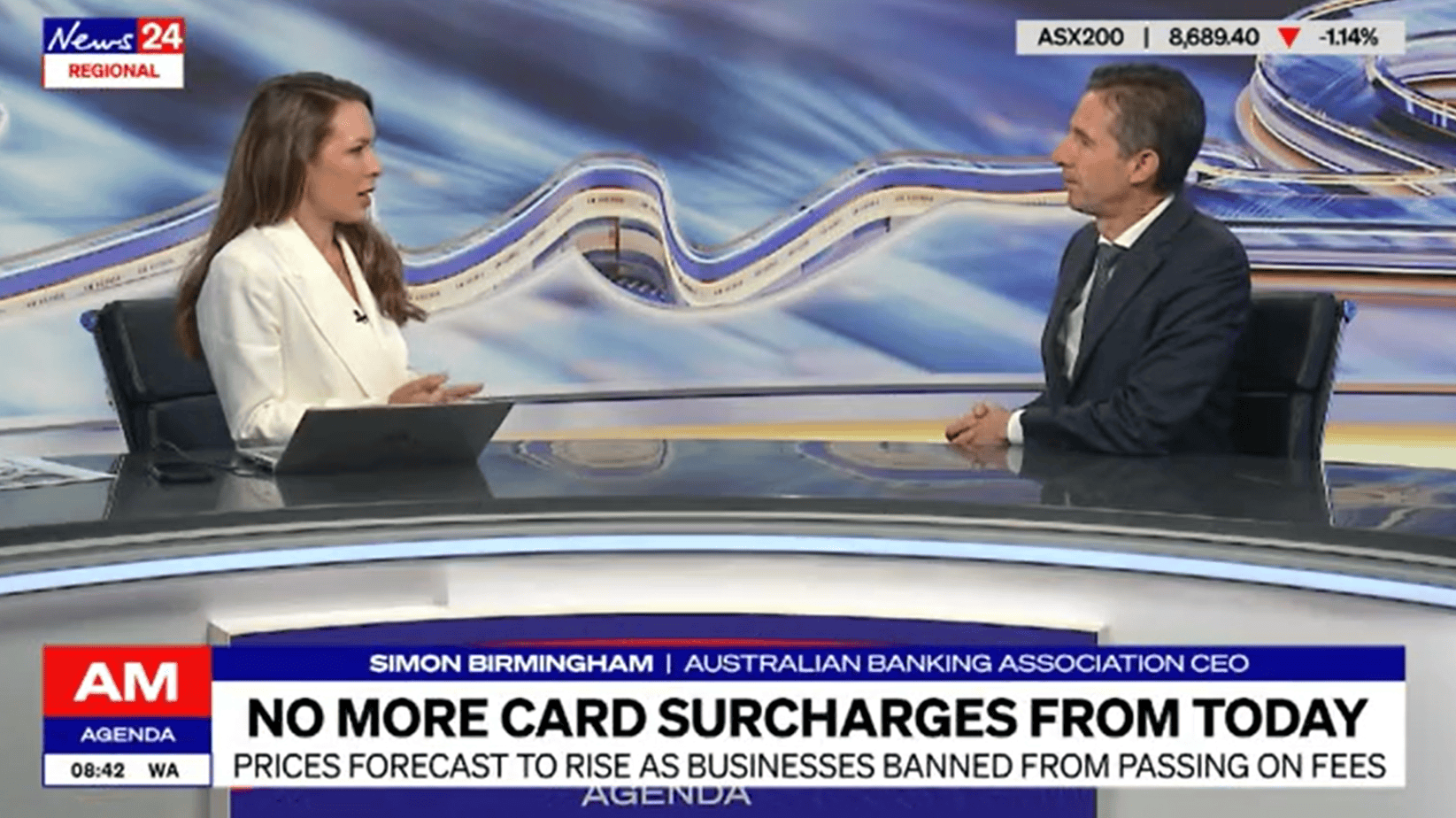
Interview on News24 AM Agenda
1 October 2026
Topics: Card surcharging ban; Interest rates; Refinancing
Laura Jayes: Well credit card, any card surcharges are banned from today. I know customers will be happy. Small business, though, they’re not so sure. Joining me live now is the Australian Banking Association Chief Executive, Simon Birmingham. Simon, great to see you. So, the surcharge is gone. The cost of processing that payment hasn’t, though. So, who’s paying for it now?
Simon Birmingham: So LJ, the RBA made a couple of decisions. One was to enable the end of surcharging, and for many Australians, that’s the end of an irritant, a bugbear, where people really didn’t like, you know I’m paying six bucks for my cup of coffee, then you look at your card afterwards, and you’ve been charged $6.18, and you feel like you’re endlessly being ripped off. They also changed what are called the bank interchange fees, so that is how much of a cut of the transaction banks actually get on the way through. And they did that by reducing the cap from 0.8 per cent down to 0.3 per cent, so it’s a big cut. They’re already low by world standards, they’re now essentially about the lowest in the world, and the RBA estimates that just for Australian cards, that’ll save small businesses around $660 million, and when extended out to international cards, goes up to about $900 million in terms of savings that flow through the system, which obviously will offset that loss of surcharging for some small businesses.
Laura Jayes: Right. So, the interchange revenue, it’s not just going to be absorbed by the banks, I assume. What are the downstream effects of that, if you like?
Simon Birmingham: So, I mean, there’s two parts. They’re not the only fees that exist in terms of card transactions. So, the scheme providers, Visa and Mastercard have fees, Apple takes a cut when you double-click your phone. So, there are a range of other fees, and then there are those outside of this regulated environment, like Amex. So, we’ve been pretty clear that acknowledge what the RBA has done, they actually do need to now have a look at all of those other parts of the ecosystem, particularly those global multinationals who are taking a bigger cut out of the Australian payment system, but don’t actually invest back into it.
Laura Jayes: Right. So, what happens? Okay so the big four aside. What happens with someone who’s got an Amex, for example? Can these businesses still charge an Amex surcharge fee?
Simon Birmingham: Amex themselves have decided to move at the same time and say no. Now that’s up to them. Small businesses may or may not choose to accept that card, and of course that could be one of the consequences, be it an Amex or be it bank issued Visa and Mastercards, that we see some businesses say, actually we’re just not going to accept card payments anymore. That’s their choice. Of course, every payment type comes with some degree of costs, and that should always be acknowledged. Even cash, yes, we pass around cash for free, but when it comes to a business handling cash and the transaction costs, the accounting costs, the banking costs, all of that is time in a business, whereas many of the things when people pay by card are automated and free up time for a small business person. So, they’ve got to weigh each of those factors when they think about what the impacts are.
Laura Jayes: So, this seems like an unfairness here, and you know no one’s going to cry about the banks, obviously.
Simon Birmingham: Nope, banks are quite used to that.
Laura Jayes: Yeah, but there seems an unfairness here with things like Apple Pay and you know big international conglomerates. That’s not addressed with these changes, is it?
Simon Birmingham: It’s not. Now, while the Reserve Bank was undertaking this work, the government and the parliament did put through some legislation that expanded the scope of the RBA’s powers, so they can now look at these other aspects. They can look at the card scheme fees, Visa and Mastercard. They can look at your digital wallet and your Apple-type fees. They can look at what are called three-party schemes.
Laura Jayes: Apple’s the big one, right?
Simon Birmingham: You think about how much Apple has grown and the market share they command in the Australian mobile phone market, and then how widely pretty much everybody with an Apple phone uses it to pay, and it’s not transparent. So, we do want the RBA to use those powers at the very least to force some transparency. Estimates are that around 15 basis points, so 0.15% is clicked off to Apple every time. Now the ATO has released its corporate tax data today. Of course, the big banks are all there amongst the big taxpayers, as they should be.
Laura Jayes: Where’s Apple?
Simon Birmingham: Yep, you got to look long and hard down the list, long, long, long way down, and this is the challenge in terms of many of those global multinationals that they structure in ways where the ATO has to work very hard to try to ensure that they are paying their fair share of tax, and they don’t invest in the Australian payment system. In the end, the rails on which all of that money moves and those payments happen don’t just exist without investment. Banks invest billions of dollars to build those systems, to put in place fraud preventions and other cyber safety and security aspects, and that’s just a reality that has to be invested, banks will continue to do that. But if they’re seeing a greater share of that payments money go offshore, it makes it harder to maintain the sovereignty of our investment in a world-leading payments system.
Laura Jayes: It’s important to explain the complexity of this because when it comes down to it, Simon, who is actually the great beneficiary of these changes that start today.
Simon Birmingham: So, look, I think there’s a simplicity to it is kind of the simplest way I could say for a beneficiary. I think the RBA and the government have addressed an irritant and an annoyance. Does it create a meaningful change? No. Our concern certainly is that, in terms of the fee structures that do exist, it changes the balance significantly away from Australian-owned, Australian-operated businesses that invest in modern, secure, productive payment systems for Australia, and leaves a greater share potentially going offshore, and that the RBA needs to – and they’re flagged they are going to do this work, but they need to do it as quickly as possible, as thoroughly as possible – to create regulatory equivalents. Banks don’t seek a special deal, but they do want to ensure that the other players in the ecosystem are treated in the same way.
Laura Jayes: Let’s talk about the latest interest rate rise. The big four banks have now said that they will pass it on to customers. Would you expect, I think we would expect that savers would get the same treatment.
Simon Birmingham: Yes, absolutely, and we’ve seen some already publicly flag that and make those moves, and certainly over the other rate increases that have occurred during the year, we’ve seen those types of moves occur as well. So, for savers, there is an upside there, and it’s a very competitive market. Not just the home loan market or the small business lending market, but the deposit market is actually really competitive at present as well. So, we have seen that battle between banks, not just the big four, but others within the banking system really step up in terms of their effort to attract and hold depositors as well as borrowers, and that is creating a more attractive environment, at least for people to shop around. Of course, if you’re on the borrowing side, it’s tough, it’s bad news to see those rate increases, but again, around 670,000 people switched their mortgages last year. They overwhelmingly did so, not because they had to, but because they chose to, because they found a better deal somewhere, and it shows that shopping around, mortgage switching is an option in a highly competitive environment.
Laura Jayes: Okay, Simon Birmingham, great to see you here in the studio.
Simon Birmingham: Thanks, LJ, bye.
Ends
Latest news
E&OERadio InterviewInterview on FiveAA Adelaide1 October 2026 Topics: Card surcharging ban Stacey Lee: Well, speaking of budgets, everyone’s are tight at the moment and they might get a little bit tighter from today because card surcharges have come to an end. It’s the first of October. It’s a deadline on a whole lot of things,… Read more »
E&OERadio InterviewInterview on ABC Adelaide1 October 2026 Topics: Interest rates; Hardship support from banks; Card surcharging ban Sonya Feldhoff: Simon Birmingham is the CEO of the Australian Banking Association. He’s also a former SA senator and finance minister. So, all of these things have been very much in his purview for a long time. Simon… Read more »
E&OERadio InterviewInterview on ABC Radio National Hour30 September 2026 Topics: Interest rates; Competition in home loan market; End of card surcharging Fran Kelly: In another ugly day for economic data, with headline inflation jumping to 4 per cent driven by surging petrol and building costs, while the other key figure, the trimmed mean inflation, remains… Read more »