
8 February 2026
E&OE
TV Interview
Sky News Business Weekend
8 February 2026.
Topics: Interest rates, the payments system, the coalition.
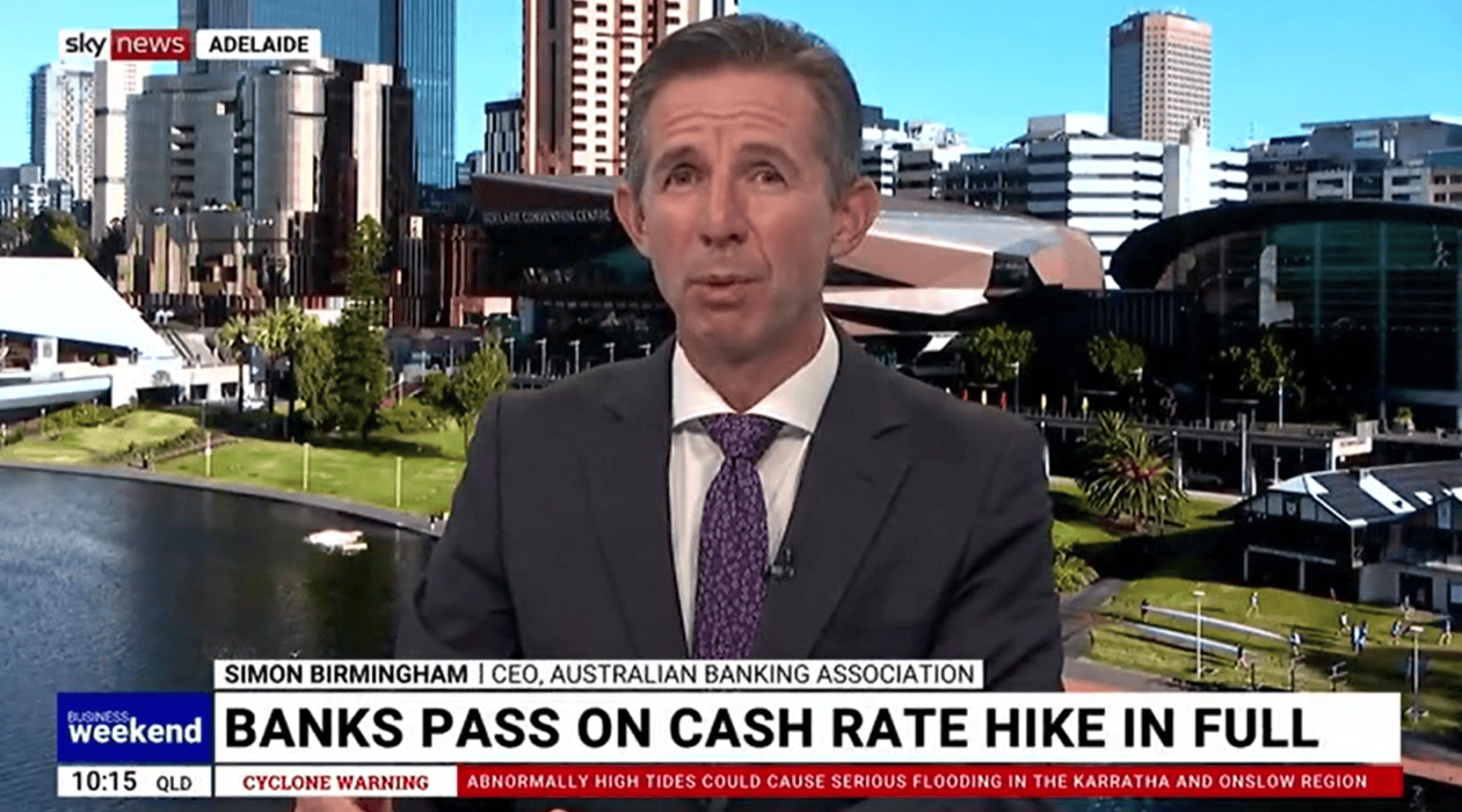
Ross Greenwood (Host): The other industry that will come into the political spotlight, clearly, are our banking sector and our major lenders. Their actions for now, broadly mirror the Reserve Banks, but you can imagine that as a group, the banks have to be extremely cautious about outsized interest rate movements, or indeed trying to get too much ahead of the curve in anticipation of future rate rises, because that could bring swift political retaliation from a government that has right now extraordinary power. One man who knows both sides of this ledger is Simon Birmingham, the Chief Executive of the Australian Bankers Association and the former leader of the Senate for the then Coalition government. I spoke to him a short time ago.
Simon Birmingham (Guest): Well hello Ross, it’s great to be with you. The industry has responded, as I think people would expect it to. If we look back over last year, where there were three rate cuts that were passed through to mortgage lenders and compare indeed, the last actions of those, the last rate cut was passed through to mortgage lenders over a period of between three and 14 days for that reduction in interest rates, this increase in interest rates – as the ABA has lifted the cash rate – that is being passed through to mortgage lenders in between 10 and 17 days, when you look at the major mortgage lenders across the market. So, you can see, in fact, that the old myth that banks are quick to pass on a hike, but slow to pass on a cut doesn’t actually hold and in fact, in some instances, we’ve got banks who are acting, or did act, more swiftly to pass on the cut than they are the hike, but they’re all facing quite tight net interest margins at present. That does mean that in terms of the way they are responding, it’s unsurprising that they are moving this year, as they did last year, in tandem with that official cash rate.
Ross Greenwood: But do you get a sense that banks really have to be careful politically in terms of their own sort of judgments? I mean, pre the Royal Commission, of course, they were seen to have put profit ahead of their customers. Do you think that’s a message that’s now well taught and also given even the inquiries into supermarkets over the past few years of over the so-called cost of living crisis, the banks themselves must step carefully right now.
Simon Birmingham: Ross, of course, the scrutiny that is applied to banks is significant, and given the unique position they hold in society as authorized deposit taking institutions, as custodians of the wealth and the day to day finances of the vast majority of Australians then that scrutiny is appropriate and no other sector necessarily has the same degree of political scrutiny, where routinely major business chief executives come before parliamentary committees where the range of regulators from APRA and ASIC through to the Reserve Bank and AUSTRAC and so on are all applying that scrutiny.
But we should also be mindful that it’s not just that scrutiny and that public accountability as to why banks are responding carefully and in sync. It’s also the fact that they are in a highly competitive environment. We see some of the most competitive action when it comes to mortgage interest rates and mortgage products that we’ve seen in a long time, and that has seen over the year to September last year, around 670,000 Australians refinance their loans. That’s up 20 per cent on the preceding year. So, it shows that Australians are shopping around much more. We also see that around 85 per cent of Australians are ahead in their mortgage repayments at present and more than a third of Australian mortgage holders are, in fact, more than two years ahead of their mortgage repayments, and that again, reflects the more innovative and flexible products that people can access alongside their mortgages, offset accounts and ability to make voluntary repayments than what existed many years ago.
Ross Greenwood: So, I know this week also you’ve spoken about one other aspect of Australian banking, and that is the payment system. Now the payment system, previously has been, or has always, traditionally been, managed and owned, really, by the big banks and also the major retailers. But of course, now you’ve got international companies coming into this space. You’ve got the likes of Apple, you’ve got Google Pay, you’ve got Samsung sitting in there as well. I just wonder whether there’s a real concern right now that at some point, if action is not properly taken, that our payment system shall be governed by foreign entities, by foreign businesses that really don’t necessarily come always under the jurisdiction of our government.
Simon Birmingham: Ross, this is something to watch really carefully and closely. We’ve seen huge change in the payment system, welcome change in some ways, like Australian consumers have more choices with less friction to make payments on a daily basis than any really anywhere else in the world. Certainly, as good as anywhere else in the world, and the innovation we’ve seen alongside the safety and security does put Australia in a great position there, but we’re also seeing huge transformation in what Australians choose to do. You just go back a few years, and we had around 1 billion digital wallet payments per annum. We’re now running at about 20 billion digital wallet payments per month. So, we’ve seen this huge surge in people using their phones for convenience to be able to pay. What does that mean? Well, it means more of the money that transfers to fund that payment system when you click and you make those payments is going off to multinational tech companies, to companies like Apple and so that change in the economics of the payment system means that the Australian companies, Australian banks and others involved in the payment system have less left over to invest in that system, to invest in innovation and to keep the sovereign capabilities that we want to have in Australia for a strong, stable banking system.
And so this is something to be watched very carefully. There’s a new House of Representative’s inquiry looking at the payment system, m sure they’ll be scrutinising this. And the Reserve Bank, in finalising their review of surcharging, no doubt will be weighing this quite carefully and making sure they aren’t making decisions that disrupt that or empower those foreign players to a disproportionate extent.
Ross Greenwood: And look, Simon, I wouldn’t be doing my job unless I asked you about politics right now, as a former Leader of the Senate for the then Coalition Government, and obviously a former Finance Minister as well, I just want to ask you about your own view on the split between the Liberals and the Nationals, and really what’s brought it to this point, and your own sense of the future of those two conservative parties?
Simon Birmingham: Well Ross you are being a very diligent journalist by asking, Look, I would say, and I think this is where most Australians are at right now. It’s less about where they sit and more about what they stand for and where they go in terms of the policy offerings of the future. Any party in the current environment that wants to be relevant to voters and attract support from voters needs to be making sure they are offering things that appeal to those voters, and not just in terms of buying their votes or pork barrelling. I think Australians are interested in seeing the big issues fixed, tackled, stronger vision for the future, and certainly for my old side of politics, and I’m not engaged in partisan politics anymore, but I think Australians are ready to see parties that are looking for strong, bold economic policies that will strengthen Australians financial position into the future, ensure that they have the opportunity to get ahead in life, whether that is buying a house, managing their finances, planning their retirement and bold, strong policies, in that sense, are the only way, whether in coalition or out of coalition, to make sure that they are getting ahead.
Ross Greenwood: So just one quick one, is it regretful, in your opinion, that the two parties have come to this position?
Simon Birmingham: Oh, I think in terms of Australian democracy and the strength of choice for Australians between parties of government. Of course, it’s regretful to see a situation where it looks like one side appears significantly less competitive at present. Democracy is best served by having strong oppositions, strong governments and a contest of ideas around those policies and the future of the country, not debates about how they’re internally structured or organised.
Ross Greenwood: Simon Birmingham, Chief Executive of the Australian Bankers Association. Always good to chat to you many thanks for your time today.
Ends
Latest news
The ABA welcomes government consultations on proposals to enhance consumer protections and reform the Compensation Scheme of Last Resort (CSLR) to ensure it is financially viable into the future. ABA CEO Simon Birmingham said the current model was not operating as originally intended and banks supported steps to reduce investment losses and redesign CSLR to… Read more »
Jim Chalmers: Thanks for joining us. I’m here with the Small Business Minister, Anne Aly, Bran Black, the head of the BCA, Skye Cappuccio from COSBOA, Simon Birmingham, from the ABA as well. We’ve got a bit to run through today to give you a sense of the work that we are doing together. But… Read more »
E&OETV InterviewSky News Afternoon Agenda1 April 2026. Topics: hardship support from banks; RBA decision on surcharging and interchange. Laura Jayes: I want to bring it back to the situation we find ourselves in economically now. A lot of you are hurting. Petrol prices are pushing up really the cost of everything. Joining me now is… Read more »