

What is Confirmation of Payee?
Confirmation of Payee (CoP) is an industry-wide service that checks the name of the person or business you intend to pay against the account details you enter. Before a transfer is made, you’ll be notified if the name on the receiving account doesn’t match, helping reduce scams and mistaken payments.
Since July 2025, banks across Australia have been rolling out Confirmation of Payee, now live at participating banks nationally. This added layer of security gives customers greater confidence when sending money.
How it works
When you make a payment, you may be asked to provide:
- The account name
- The BSB
- The account number
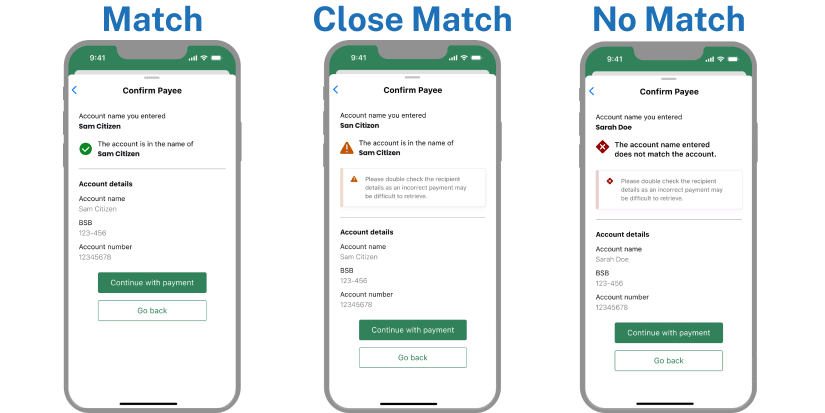
Your bank will then check these details and return a message confirming whether the name matches:
- Match: the name and details match. You’ll see the account name so you can confirm it.
- Close match: the name is similar, but not exact (for example, “John Smyth” instead of “John Smith”). You’ll see the account name so you can check it.
- No match: the name doesn’t match the account. For personal accounts, the account name won’t be shown.
You’ll be able to review this information before deciding whether to proceed. You may also see a message that the account has been closed, that no account was found, or that the check couldn’t be completed. If in doubt, confirm the details with the person you’re paying before sending any money.
Is it available now?
Confirmation of Payee began rolling out from July 2025 and is now available at participating banks across Australia. A national education campaign supported this rollout, helping Australians understand what to expect and how to use the service.
- 150m+times used in its first year
- 100+financial institutions now offer it
- 8 in 10Australians have seen or used it
- $100minvested by banks to build it
“This technology is doing its job. It’s saving customers money by warning them that they could be about to send money to a dodgy scam account.”
Simon Birmingham, ABA CEO, March 2026. Read the media release
Banks have launched a new weapon in the fight against scammers
Watch how banks are using cutting-edge technology to help protect customers from being tricked into sending money to criminals. This campaign was developed in partnership with the Customer Owned Banking Association and Australian Payments Plus.
Stay scam safe
- Confirmation of Payee will never contact you, ask you to send money or ask for your account details. Emails or texts claiming to be from Confirmation of Payee are a scam.
- If you get a no match, check with the person or business using contact details you already trust, not the ones in an email, text or invoice.
- If you think you’ve been scammed, contact your bank immediately. Find out what to do or report it to Scamwatch.
FAQs
How does Confirmation of Payee work?
When you key in a BSB, account number and the payee’s name for the first time (or when you edit an existing payee), your bank sends those details to a central matching service run for the industry by Australian Payments Plus (AP+). The recipient bank checks whether the name on its books matches the name you entered and returns a “match”, “close match” or “no match” result in real time. A simple traffic-light message then appears on your screen so you can decide whether to proceed, double-check or cancel before any money leaves your account.
How do I access Confirmation of Payee?
You don’t need to do anything. Confirmation of Payee appears automatically in your banking app or online banking at participating banks.
Have banks delivered on their commitment to roll out Confirmation of Payee?
Yes. Banks committed to rolling out this technology during 2025 and have delivered on that commitment. Implementing an industry-wide Confirmation of Payee system required a significant build and investment. It’s further demonstration that Australian banks are leading the way when it comes to safeguarding their customers.
How much did it cost to build and who paid for it?
Banks invested $100 million to design and build the national Confirmation of Payee platform. All of that funding came from Australia’s major, regional and customer-owned banks, which voluntarily committed the money under the industry’s Scam-Safe Accord well before any regulatory mandate. No taxpayer or government funds were used. The sector stepped up on its own to deliver this extra layer of protection for customers.
The platform was designed and built by Australian Payments Plus, the organisation behind PayID, Osko, BPAY and eftpos.
Have banks completed the projects in the Scam-Safe Accord?
Yes. All Scam-Safe Accord initiatives are now complete. These include biometric checks, limits on payments to high-risk crypto platforms, enhanced intelligence sharing, the development of anti-scam strategies, warnings and payment delays, and Confirmation of Payee. Find out more about the Scam-Safe Accord.
How is it different from PayID?
Think of PayID as the “easy-to-remember nickname” for an account: you type in a mobile number or email address, your bank shows you the name on file, and off the money goes. That works brilliantly when the person you’re paying has set up a PayID, but plenty haven’t.
Picture paying a plumber who just texts you a BSB and account number on the spot, or settling an invoice from a small tradie who prints those details on the bill. In those moments, Confirmation of Payee becomes the star player: it lets you know instantly whether the name you’ve entered matches the account you’re paying.
In short, PayID makes paying simpler and CoP makes traditional payments safer, giving Australians an extra line of defence against misdirected transfers and invoice redirection scams.
Which banks have Confirmation of Payee?
Confirmation of Payee is now live at more than 100 financial institutions nationally, including banks, credit unions and mutual banks, having rolled out progressively from July 2025. To check whether yours offers it, use the search tool on the Australian Payments Plus website or contact your bank.
What personal data is exchanged between banks during a CoP check, and how is privacy protected?
Only the BSB, account number and the name you type are sent to the industry hub run by AP+. The recipient bank compares those details to its own records and sends back a match, close match or no match result. All underlying account data stays inside each bank and there is no central database.
For personal accounts, the account name is only shown to the person paying if there is a match or close match. If there is no match, the name is not revealed. For business and government accounts, the account name may be shown regardless of the result. Eligible customers can also ask their bank about opting out.
If the system returns a “close match” or “no match”, can a customer still proceed with the payment?
Yes. CoP is an advisory checkpoint, not a hard block. After a close match or no match alert you can correct the details or choose to continue. Money sent to the wrong account can be difficult to recover, which makes the CoP warning a critical last line of defence.
If you think you’ve paid the wrong account or been scammed, contact your bank immediately. If you’re not satisfied with your bank’s response, you can lodge a complaint with the Australian Financial Complaints Authority (AFCA).
Why might I get a close match or no match when the details look right?
This can happen if a business trades under a different name to the one on its account, or if you’ve used a nickname rather than the account holder’s full name. You don’t need to enter special characters, so “O’Brien” can be entered as “O Brien” and “Paper & Pen” as “Paper Pen”. If you’re unsure, ask the person you’re paying for the exact name on their account.
What safeguards are in place so fraudsters can’t game the system by tweaking account names?
The matching allows for ordinary typos but not wholesale name changes. For personal accounts, the recipient’s name is shown only when there is at least a close match. A no match response simply withholds the name, depriving criminals of useful clues.
Does CoP cover international transfers or just domestic payments?
Confirmation of Payee is a domestic safeguard. It works on Australian payments made using a BSB and account number, and doesn’t check accounts held overseas. Customers sending money overseas should keep using their normal checks and controls.
Can businesses use Confirmation of Payee?
Yes. Businesses see Confirmation of Payee results when paying suppliers, staff or customers through their online banking. If your business receives payments, include your exact account name, BSB and account number on invoices, particularly if you trade under a different name.
What other countries have this technology?
Early adopters include the Netherlands (2017), the UK (2020) and New Zealand (2024). Australia joined them in 2025 with a nationwide name-checking safeguard funded entirely by its banks. Since October 2025, payment providers across the euro area have also been required to offer a similar check, known as Verification of Payee.