
- Businesses can charge a surcharge for paying by card, but the surcharge must not be more than what it costs the business to use that payment type.
- If a business charges a payment surcharge, it must be able to prove the costs it is based on.
- If there is no way for a consumer to pay without paying a surcharge, the business must include the surcharge in the displayed price.
Understanding the end of card surcharges
Download the PDF versionFrom 1 October 2026, businesses will no longer be able to add a surcharge when you pay with eftpos, Visa, Mastercard.
American Express will also adopt this change.
That means no extra fee for tapping or inserting your card at the checkout.
This change comes from reforms by the Reserve Bank of Australia. The goal is simpler, more transparent pricing for customers and businesses.
In most cases, the price you see will be the price you pay.
Some other charges, like weekend or public holiday surcharges, are not affected by this change.
Banks have reduced their fees
As part of these reforms, banks have reduced the fees they charge for debit and credit card payments.
The Reserve Bank has cut these fees to some of the lowest levels in the world.
For example, the maximum fee a customers’ bank can charge to small businesses on a consumer credit card payment drops from 0.8% to 0.3% of the transaction, or from 80 cents to 30 cents on a $100 purchase.
The expectation is that lower payment costs will help businesses and customers.
But banks are responsible for only some of the fees on card payments.
If costs don’t come down for small businesses, it is because other companies in the payments chain (such as Visa, Mastercard, Square or Tyro) have raised their fees while banks have reduced theirs.
Why might I still see a card surcharge?
Some small businesses may still need to update the settings on their payment machines.
Banks will disable the surcharge function on the machines they control. You may notice occasional surcharges for a short time while remaining businesses update their systems.
Card networks (like Visa, Mastercard and eftpos) and payment providers (like Square, Tyro, Stripe and some banks) are responsible for enforcing the new rules.
If a surcharge is still being charged after 1 October, it is up to those organisations to address it.
What this means for you
- The price you see should be the price you pay.
- You should no longer need to check for card surcharges.
- Businesses may include payment costs in their normal prices instead of adding a separate fee at the checkout.
Quick facts
What changes?
Card surcharges end.
When?
1 October 2026.
Who is covered?
eftpos, Visa, Mastercard and American Express card payments.
Who enforces it?
The card networks and payment providers.
Summary
- From 1 October 2026, businesses will no longer be able to add surcharges to most card payments. The price you see should be the price you pay.
- The change follows reforms by the Reserve Bank of Australia designed to make pricing simpler and more transparent.
- Banks have already reduced their fees as part of these reforms. The next step is for the rest of the payments system to ensure those savings flow through to consumers and businesses.
“The 10 per cent of small merchants that currently surcharge would need to either absorb their payment costs in their margins or incorporate these costs in their advertised prices.”
Review of Merchant Card Payment Costs and Surcharging – Consultation Paper (July 2025), p. 10
“A majority of small merchants (85 per cent) do not surcharge and will not be impacted by the removal of surcharging. Merchants that currently surcharge will need to incorporate their payment costs in their advertised prices.”
Review of Merchant Card Payment Costs and Surcharging – Conclusions Paper (March 2026), p. 98
RBA Review Results: New Rules for Card Payments
On 31 March 2026, the Reserve Bank of Australia (RBA) released its final report into merchant card costs, its Conclusions Paper following the Review of Merchant Card Payment Costs and Surcharging. The Payments System Board concluded that a significant package of reforms is necessary to promote competition and efficiency in the Australian payments system.
What was decided?
- Removal of Surcharging: Surcharging will be removed on all debit, prepaid, and credit cards on the designated eftpos, Mastercard, and Visa networks.
- Lower Interchange Caps: The RBA will lower the caps on interchange fees paid by Australian businesses to help offset the removal of surcharge revenue.
- Increased Transparency: New rules will increase transparency over the fees charged by card networks and payment service providers, making it easier for businesses to compare costs.
- Implementation Date: Most of these changes, including the surcharging ban and domestic interchange reductions, will come into effect on 1 October 2026.
The ABA has reviewed the RBA’s Conclusions Paper and responded publicly to the reforms. Until 1 October 2026, the current surcharging guidelines (outlined below) remain in force.
Ban on excessive payment surcharges
How much it costs a business to process a payment depends on the size of the business, the technology used, and the payment method.
Ban on excessive payment surcharges
How much it costs a business to process a payment depends on the size of the business, the technology used, and the payment method.
This ban on excessive payment surcharges applies to:
- Visa
- MasterCard
- Eftpos
Generally the ban does not apply to other electronic payment methods. These include, but are not limited to:
- Buy now pay later (BNPL)
- PayPal
- Diners Club
- American Express
- taxi fares, whatever the payment type
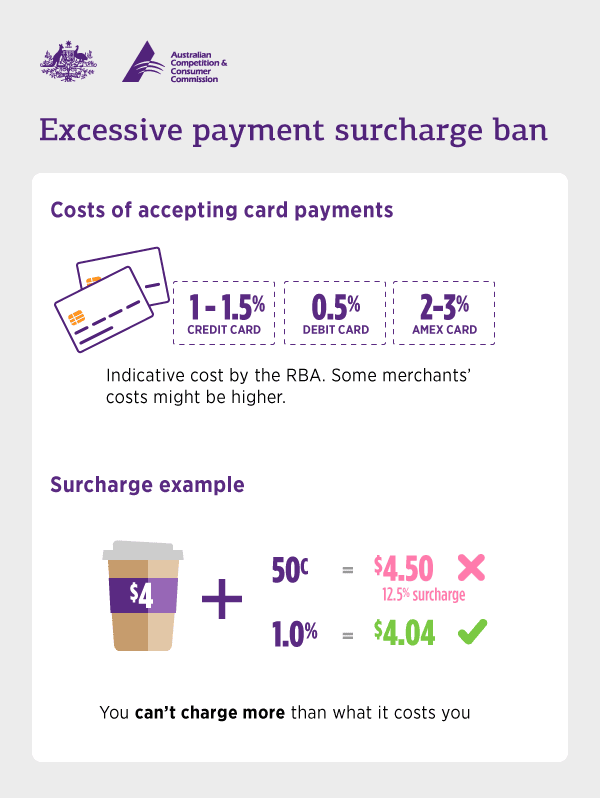
Costs that businesses can include
The Reserve Bank of Australia sets out the costs that businesses can include when determining their reasonable costs of accepting payment types.
Before introducing a payment surcharge, businesses should read the ACCC’s Payment surcharges guide and the Reserve Bank of Australia guidance material. Consumers may also wish to read these guides for further information about how excessive payment surcharges are calculated.