
1 April 2026
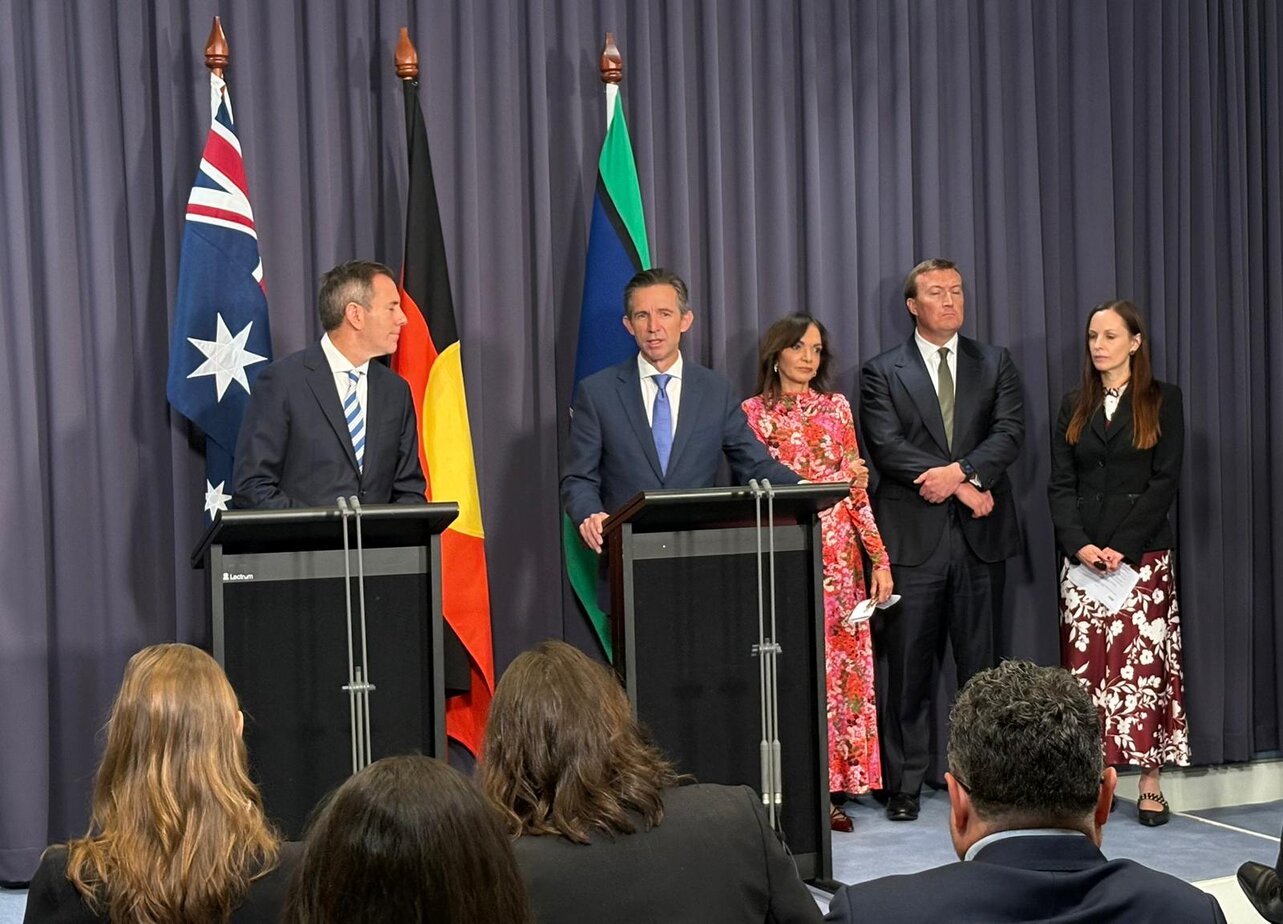
Jim Chalmers: Thanks for joining us. I’m here with the Small Business Minister, Anne Aly, Bran Black, the head of the BCA, Skye Cappuccio from COSBOA, Simon Birmingham, from the ABA as well. We’ve got a bit to run through today to give you a sense of the work that we are doing together. But first I wanted to say, obviously, that the war in the Middle East is having an extreme impact on the global economy. Australians and Australian small businesses are paying the price for that. And what we’ve been doing, really, throughout the duration of this war, the last month or so, is making sure that we’re closely engaged with the business community, with the union movement and with others to make sure that we’re working together the best that we can to try and get Australians through what is an extraordinarily difficult time.
We’ve been doing that, obviously, bilaterally, with the major companies, and we’ve also been doing it with the peak organisations, and I really wanted to begin by thanking Bran and Skye and Simon and their colleagues and counterparts in all of the peak business groups, as well as Sally McManus and the ACTU for the work that we have been doing together. Just in the last month or so, I’ve been meeting with the CEOs and chairs and country presidents in sectors like mining and fuels, banking, supermarkets, telcos, technology, automotive, peak groups, and also a couple of Fridays ago, I brought together the economic regulators by convening a meeting of the Council of Financial Regulators as well.
So a lot of the work that we are announcing today is informed by really working right around the clock with the business community, the unions and others, to make sure that we’re doing the very best that we can on behalf of Australians and Australian small businesses in particular, businesses more broadly as well, to try and shield them from the worst the world can throw at us, the consequences of this very substantial oil shock emanating from a war in the Middle East.
So we are working closely with business finance and others to help ease the pressure on Australian families and small businesses. We know that the fallout is affecting everyone, but we believe that by working together, if everybody does their bit, we can get through this difficult period. So we’re coordinating this action by regulators, industry and the broader community to help Australians doing it tough. And today is really about announcing further support, whether it’s from the government point of view and the ATO or from the business community, and I’ll throw to them in a moment to run through some of the steps that they are taking.
Our objective here is to provide support and to provide flexibility, the 2 most important things that we can help with at a really difficult time. And so what we’re announcing today will make our systems more flexible, our supply chains more responsive, and also businesses more supportive as well. So there’s really 3 parts of what we are talking about today. The first one is about the tax system, the second one is about small business access to credit, and then thirdly, finance sector and broader industry support as well.
In the tax system, we’re announcing new measures to give people more flexibility.
The ATO has agreed to provide temporary relief for businesses unable to meet their tax obligations due to fuel supply issues, where that’s appropriate. This could include more generous payment plans, remission of interest and penalties, and also support in various PAYG instalments where there’s been a downturn in taxable income.
They’ll also limit compliance actions across the worst affected industries, and some debt collection actions may be paused where that’s appropriate. Obviously, we still want people to lodge. Obviously, there is a threshold for where this kind of concessional treatment will be provided, but the ATO is prepared to provide that kind of support in circumstances which are obviously because of what we’re seeing in the Middle East.
They’ll also establish a dedicated channel that businesses can use to access these relief provisions, or obviously, they can contact their usual tax professional to request access on their behalf.
The ATO will continue to provide support for people experiencing serious financial hardship, and they’ll also monitor conditions in the lead up to tax time.
These are common sense steps that recognise and respond to the extraordinary circumstances we find ourselves in. I really wanted to thank Rob Heferen, the Tax Commissioner, and all of his team, for the work that’s gone into these steps that we’re announcing today.
Secondly, and Anne will come back to this in a moment in a little bit more detail, we are going to help small businesses access easier and faster credit by extending the Small Business Responsible Lending obligation exemption for a further 10 years. This will help ensure small businesses aren’t slugged with additional regulatory burden and delays when they’re accessing loans. Anne will come back to that in a second.
The third category, and here again, I thank Skye and Bran and Simon for the work that we’ve been doing together, is the support in the finance sector and the broader business community. We really welcome the commitments that have been made to proactively work with customers, suppliers and employees to respond to pressures in the economy. I know that the banks and the non‑bank lenders have put in place specialist teams to support small businesses and farmers and communities struggling with cost pressures and supply chain disruptions as a result of the war in the Middle East. A number of options are available to customers doing it tough, whether it be temporary, payment deferrals, loan restructuring, emergency credit limit increases, all of that, obviously, depending on individual circumstances, but some support being made available there.
Simon will no doubt talk about the ABA campaign in this regard, and obviously all of the banks, whether the customer owned banks, the banks that Simon represents as well, obviously they are encouraging customers who are experiencing a hardship to get in contact to see what arrangements can be made. The sooner that people do that, the better so that these discussions can be had.
I know that a number of members of Bran’s organisation, the BCA, are taking a number of actions as well in response to the crisis, whether it’s paying suppliers more frequently to help with cash flow, ensuring higher fuel costs are being reflected in what suppliers are paid, targeted support for vulnerable customers, whether it’s discounts, structured support, bill pauses, tailored payment plans and account reviews, all of that, I think is very helpful and very welcome from our point of view.
The Insurance Council of Australia is working with its members to better support customers with their hardship assistance. And obviously there’s a small business element to that as well. We encourage small business owners to talk to their insurer about adjustments to premiums during this time, obviously, they’ll continue to work through their members on some of these sorts of steps.
We’ll continue to work with industry and unions and others. We’ll continue to do this work, really around the clock during the depths of this very substantial economic challenge, this economic shock to make sure that we’re doing what we can for people. Obviously, if and when additional steps beyond those which we’re talking about today are necessary, obviously, we’ll consider them. We’ll work through them in the usual consultative, collaborative, considered, but also urgent and decisive way, which has been the hallmark of the way that the Prime Minister and his team and the community more broadly is responding to these pressures.
We’ll go to Anne and then Bran, and then Skye and then Simon.
Anne Aly: Thanks, Treasurer. We all know that running a business, a small business, can be tough, and it can be particularly tough when there are unexpected shocks due to global events like the current war in the Middle East. I just want to take a moment to thank all of the small businesses, as well as the peak bodies, COSBOA among them, who have come to me over the last month and engaged with the government on what can be done to further support small business.
What the Treasurer and I are announcing today is a suite of measures that are designed to shield small businesses from the worst of these global shocks that are due to the war in the Middle East. Jim has gone through some of the tax flexibility that’s built into these measures that will help small businesses. One of the other things is helping small businesses to access credit.
Now we know that for small businesses, whether they rely on fuel for the goods and services that they receive in their supply chain, or whether they rely on it for the goods and services that they deliver as part of their small business. I’m thinking also of small businesses in tourism and hospitality, who, over this coming Easter period, will be wondering, you know, how they’re going to keep their doors open.
Enabling small businesses to have easier and faster and less burden, less regulatory burden, when they want to and when they need to access credit, is what this particular measure is all about: ensuring that there is no additional regulatory burden or further delays when they need to access credit to keep their doors open. And of course, there are also other measures on banking, and I’m sure Simon will speak to this, to support small businesses through this.
But I just want to reiterate what the Treasurer said. This is about our government taking responsible, well-considered measures that have been undertaken in consultation with small businesses and with the peak bodies to ensure that we are doing everything that we can to shield small businesses from the very worst of these global shocks due to the war in the Middle East.
We can’t control the war in the Middle East. We can’t stop the war in the Middle East, but what a responsible government can do is to do everything that it can, to shield its citizens and to shield small businesses in these times. Behind every small business is an individual who has an aspiration and who has passion. They give back to our community, they give back to our economy. They employ people, and because they give back to Australia, we’re keen to look after them as well, and that’s exactly what we’re doing here.
Bran Black: Thanks Treasurer and thanks minister. We appreciate the opportunity to be here. And I did want to stress that between Simon and Skye and myself, we are part of an alliance of industry associations that’s almost 30 strong, and we are working together, and we’re working collaboratively with government through these most challenging of times. I wanted to note this really is one of those points where we need a genuine team Australia response that’s not empty rhetoric. That’s about making sure that we make decisions and that we work together in a way that is ultimately advancing Australia’s needs, as I say, in a very challenging and difficult time, but it emphasises the importance of collaboration, and there are a couple of points that I wanted to make in that regard.
First and foremost, we see that there is quality collaboration already between governments and within government, and that’s so important. We’ve seen, of course, the National Cabinet stood up, that it’s met twice already. We see that there has been the national coordination mechanism that’s stood up, and we also know now that there is really good work that’s being undertaken to make sure that Australia secures the fuel supplies that it needs, and beyond that, that it’s distributed to those parts of the country where it’s needed most. What we’re also seeing, and we’re really pleased with this, is that government is reaching out to business, and we want that to continue, particularly as we contemplate different scenarios and plan appropriately and accordingly for those scenarios.
The second point that I wanted to come to is how businesses are working together, and how they’re working to support suppliers, how they’re working to support their staff and how they’re also working to support their customers, and talking from a larger business perspective. What I wanted to do was run through some key examples of how that’s happening already. The key point that I’d make, though, before I do that, is that I approached my membership in this regard, late last week to get a sense of what they’re doing and what their thoughts are for moving forward and I was inundated with responses. There is so much consideration that is already taking place.
There are so many measures that are already put in place. I don’t have time here, of course, to go through them all. But I did want to stress that right across the economy, the length and breadth of the economy, we are seeing that businesses are stepping up. Larger businesses are doing what they can to support their suppliers, their staff and their customers. Some tangible examples across that point I started with in terms of supporting suppliers and supporting small businesses, we’re seeing that retailers are already working as issues are raised with them directly by their suppliers. For instance, Coles and Woolies have changed their fuel levy reviews from monthly to fortnightly. Grain Corp in the agricultural space has continuously increased freight rates paid to transport contractors in line with fuel rate increases.
And we’re also seeing across the board that individual suppliers, that we’ve got companies that are working with individual suppliers, including those who need quicker payment times in these circumstances. And our message in this regard is very simple, if you’re in business, if you’re a small business and you’re working with a larger business, if they’re a contractual counterparty, reach out to them. These conversations are taking place and we would encourage you, if you’re experiencing hardship, to reach out and have a conversation for yourself in terms of supporting customers.
Of course, Simon will talk in due course, to the types of supports and assistance that banks can provide but if we speak to telecommunications providers, electricity providers and banks, there are already hardship programs that are in place, often are challenges that people aren’t aware of them. So we would say, get online. Google the hardship program for your provider. Get in touch with your provider. These programs exist for a reason to deal with circumstances like now.
So once again, our message is very simple, make use of these hardship programs. They’re there to support you. And then the final point that I’d make is just in terms of supporting workers. Again, there are some really useful examples that I think that we’re already seeing put in place. We know Coles, for instance, is providing longer shift hours on request to make longer commutes more worthwhile. They’re better aligning shift hours to public transport availability. Once again, if people have those types of challenges, they can reach out in the aged care space. Silver Chain is paying its staff temporary fuel support payments so that they can continue to serve their 40,000‑strong aged care clients. The simple point once again, if you are an employee and you’re experiencing challenges right now, have a chat with your employer.
If I can conclude simply by making these points, whether or not you’re a supplier, whether or not you’re a customer, or whether or not you’re a member of staff, the key thing here is communication and collaboration. These supports and assistance programs already exist and are being put in place as new issues arise, we are seeing circumstances change, and companies will continue to calibrate and recalibrate their response as those circumstances do change, but we do stress please make sure that you reach out and you have those conversations.
Skye Cappuccio: Morning, everyone, Treasurer, Minister. So we’re hearing each and every day how small businesses right across the supply chain are feeling the pressure from rising fuel costs, and how that is flowing directly into their cash flow. And in that sense, we very much welcome the government’s recognition that this requires a considered, practical and proportionate approach, and particularly a considered, practical and proportionate regulatory approach. We’re particularly grateful to hear the announcement this morning about the ATO’s temporary relief measures for small business. This this will be very much appreciated across the small business community. We also acknowledge the banking sector and larger businesses for stepping up with measures that recognise the pressures on small business and the need to support small business viability during this period.
Keeping small businesses moving really matters. As the Minister has said, small businesses are not just critical to our economy, but they’re also critical supports for local people. They’re about local jobs and they’re about local communities. We’re very much looking forward to working with the government and working further with industry as this situation evolves to make sure that we can collectively continue to keep small businesses moving. Thank you.
Simon Birmingham: Well, thanks very much, Treasurer. Had somewhat thought my Blue Room days were over.
Treasurer, thank you very much to you, to your office, the government and the Treasury, for their constructive engagement in response to the challenges that are being faced across the country. At present, Australia’s banks recognise the responsibility and unique responsibility they have to step up in times of crisis. Our banks are accustomed to doing so in regional crises such as natural disasters and of course, at times of national challenge and national economic challenge and this is no different.
Our industry is stepping up on 3 fronts, in particular, information assistance and communication in information. We are going to work and deliver more closely data and information through to government to help with the real time analysis of what is happening across the economy and where supports can best be targeted. Data shows, of course, unsurprisingly, that Australians are spending more on fuel at present, around 10 per cent more, but at this stage, we are not seeing a shift in relation to reductions consistently in consumer spending elsewhere, and that resilience is clearly there across the economy. But obviously, the longer this goes on, the greater the likelihood that will change. The resilience is underpinned by the fact that Australians have a record $1.7 trillion in household deposits, savings, effectively a record level, 8 per cent growth from last year, and that around 80 per cent of Australians are ahead in their mortgage repayments, and these provide important buffers for people at this time. However, the banking industry recognises that not everyone is in that fortunate position, and particularly there are pressures in small business, agribusiness and across those really being affected by supply chain shocks at present.
So, whilst monitoring for hardship trends and requests for assistance and providing that information to government, banks are also stepping up, stepping up in terms of the targeted assistance and teams necessary to provide specialised support. Whether you are indeed a farmer needing assistance to restructure, whether you are a small business affected by supply chain shocks, or a transport or logistics business feeling the pressure in the fuel industry, we are making sure the additional assistance is there, including for households that are under duress and pressure at this time. That assistance is tailored and targeted in each case and the message we have and the communications piece we are putting out there is very much one of urging Australians to reach out as quickly as possible if they are in distress, if you are facing financial pressures right now, get in touch with your bank. Talk to those specialist teams and talk through the options that are available in each of your circumstances. For some small businesses that will be working capital assistance. For others, it will be looking at extending lengths of loans or refinancing arrangements.
There are a range of targeted, practical steps that can be taken, and we will be launching a communications campaign across Australia, sending that clear message to Australians, don’t tough it out on your own. Talk to your banks. In addition to our communications with government, we will continue to work closely, of course, with our small business partners such as COSBOA and other industry bodies, as Bran alluded to, through the alliance of business organisations.
Latest news
E&OETV InterviewInterview on News24 AM Agenda1 October 2026 Topics: Card surcharging ban; Interest rates; Refinancing Laura Jayes: Well credit card, any card surcharges are banned from today. I know customers will be happy. Small business, though, they’re not so sure. Joining me live now is the Australian Banking Association Chief Executive, Simon Birmingham. Simon, great… Read more »
E&OERadio InterviewInterview on FiveAA Adelaide1 October 2026 Topics: Card surcharging ban Stacey Lee: Well, speaking of budgets, everyone’s are tight at the moment and they might get a little bit tighter from today because card surcharges have come to an end. It’s the first of October. It’s a deadline on a whole lot of things,… Read more »
E&OERadio InterviewInterview on ABC Adelaide1 October 2026 Topics: Interest rates; Hardship support from banks; Card surcharging ban Sonya Feldhoff: Simon Birmingham is the CEO of the Australian Banking Association. He’s also a former SA senator and finance minister. So, all of these things have been very much in his purview for a long time. Simon… Read more »