
13 May 2026
E&OE
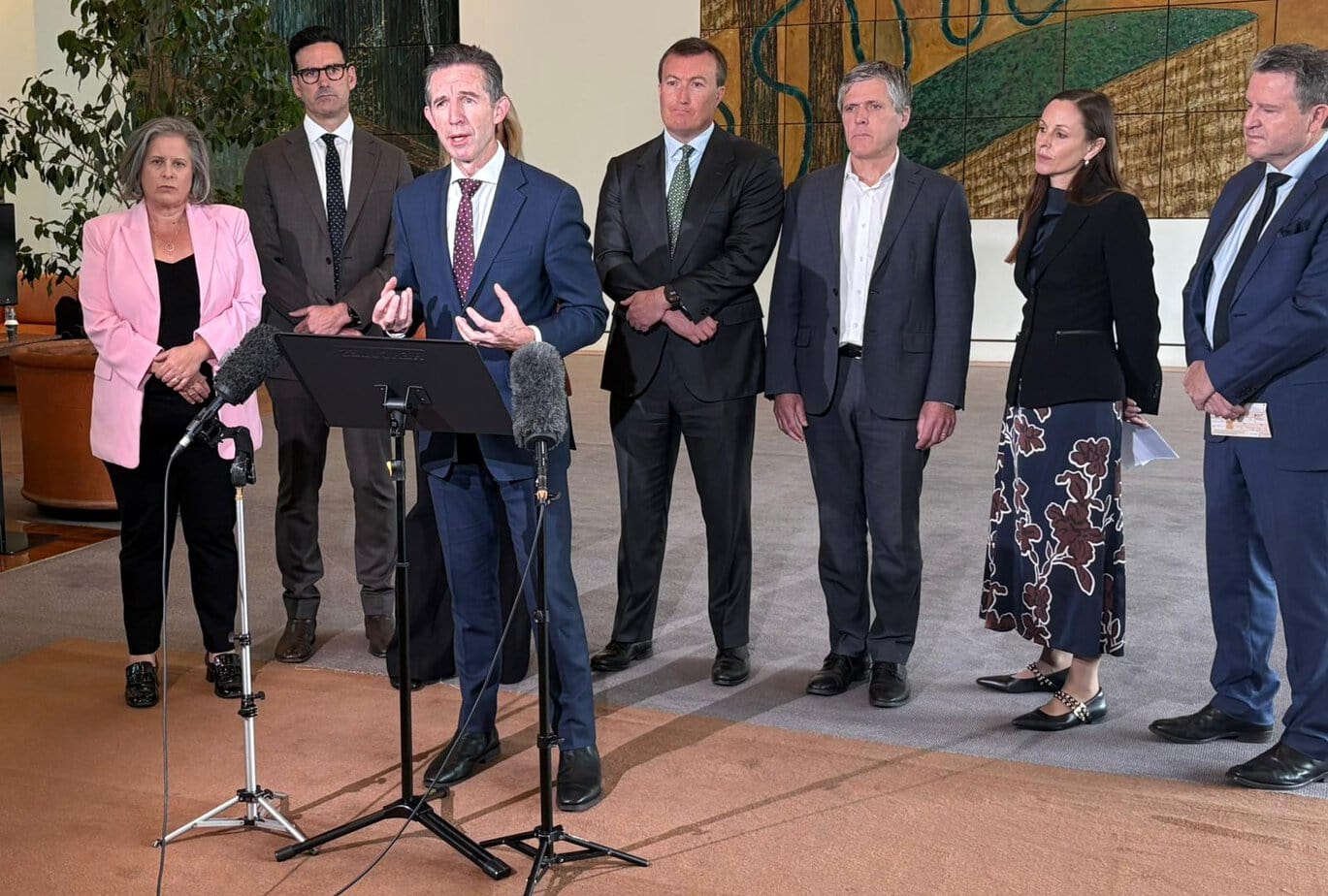
Bran Black, BCA: I’m here with colleagues from industry associations that represent the length and breadth of Australia’s economy, and we’re here today to talk about a couple of key features of the Budget. What I wanted to do is just take a step back first and just talk about how we came together. This Alliance of Industry Associations is about 18 months old, and what we did 18 months ago was fix on a series of different priorities that we thought we could advocate on together because we had a commonality of views.
Specifically, our first focus was on red tape. We also wanted to focus on planning reform. And then we also, in addition to that, saw research and development as a key priority as well. Now I thought that I’d just touch on our position in respect of those areas, in relation to the measures that have been announced in the Budget in just the last 24 hours.
Firstly, in terms of red tape, it is a massive burden on Australia’s economy, $160 billion a year. That’s 6 per cent of GDP. It affects businesses each and every day. It makes their lives harder, but it also puts up costs for consumers, and it means that overall, all Australians are worse off because of the burden of red tape on our economy.
What we’ve seen in last night’s Budget is something that we really support, that is a commitment through the Treasurer’s productivity package to reduce the burden of red tape by $10 billion. My colleagues can go into examples of the specific initiatives that have been announced in that regard that affect their sectors, but this is a really useful start. We’re pleased with that.
We want to see the Government now go further. The United Kingdom, the EU both have targets to reduce the burden of red tape by 25 per cent by 2030. We would like to see our Government take on that same commitment to reduce red tape. That is unquestionably the next step, and we urge the Government to continue its good work, working with us to deliver on that outcome.
The second point that I’ve mentioned is with respect to planning, we’ve been pleased to see the announcements that have been made overnight in that respect. The commitment for funding for supporting infrastructure like electricity and water services, roads and so forth, that enable new suburbs to get out of the ground, and then the utilisation of the National Productivity Fund to deliver on improved planning systems for states. These are great reforms. We back those in. The third point is research and development, lifting the threshold from $150 million to $200 million. Again, that’s a useful initiative, and we support that strongly.
I would add one of the other points that the Industry Alliance came together on was with respect to the proposal for a cash flow tax that was put forward by the Productivity Commission, that was not a feature in last night’s Budget, and we are very pleased by that. As we see it, that proposal would have reduced our GDP by 1 per cent, it would have been administratively burdensome for all businesses right across Australia’s economy, and fundamentally, it would have applied a model that is untested all around the world. So we’re pleased that the Government doesn’t include that.
That’s not to say that we are entirely happy with everything that we’ve seen in the Budget. We, of course, have areas that we disagree on. Individual members of the Alliance, of course, will speak to those in due course. For our part, from a BCA perspective, we don’t support the changes that have been announced with respect to capital gains tax and negative gearing. Very happy to provide further information on that.
Skye Cappuccio, COSBOA: For small business, this Federal Budget was definitely a mixed bag. As Bran has said, we very much welcome the commitments to reducing unnecessary red tape and to cutting some unnecessary compliance. Streamlining reporting for small business is also a significant win. Small businesses, at the moment, and there’s about 2.7 million of them across the country, spend six to 10 hours a week, on average, on compliance activity. That’s time taken away from working with their customers, working with their staff, and planning how to grow their business. So commitments that we’ve seen last night to reduce the red tape burden really matter. We’re hoping that they will flow through and have a practical impact on the amount of time small businesses have to work in and on their business and that matters. That matters to small business growth. It matters to small business productivity, and it flows through to the cost of living that their customers experience.
We’re also very pleased in the productivity sense, to see the announcement that the instant asset write-off will be made permanent. This is something we’ve been advocating for for quite some time, and it’s very welcome. It gives small businesses the opportunity to plan how they will invest and grow. Unfortunately, the threshold was set at $20,000 which is below what is really necessary to support small businesses, to invest in the sort of equipment and tools that many of them need to enhance their business and to grow into the future.
These are definitely positive signals in the Budget around productivity and around productivity for small businesses. We do, however, have some quite significant concerns for some of the announcements regarding tax changes for CGT and the taxing of family trusts will negatively impact small business and get in the way of their confidence and their ability to plan and invest in their own growth.
Simon Birmingham, ABA: Thanks very much, Skye. It’s nice to be back in a budget week. On behalf of the Australian Banking Association, I want to firstly, welcome the productivity measures we did see last night. There was a specific productivity package targeting the financial services industry, and that’s very important. It contains some important measures, measures that will enable small and midtier banks to compete more, which is great news for consumers and can reduce costs for those banks.
The proposal to test and trial access to ATO data for banks, which can mean that in the future, if this is adopted, consumers and customers going to get a loan will be able to have faster, simpler access to get that loan, a process involving less paper, less time, less cost for banks, better outcomes for consumers, and reduced risk of fraud. These the types of productivity-enhancing, win-win pieces that we want to see, and it’s welcome the Government has taken these steps, but this is indeed something the Government needs to double down on and repeat time and time again.
It’s why the banking industry backs the commitment for a 25 per cent reduction in red tape, not because the Federal Government needs to deliver it all, but because it’s something that should occur across the country, and by committing to that 25 per cent reduction, the Federal Government can hold states, territories, local government to account, to do their bit, to harmonise payroll taxes is proposed and welcome out of this Budget in terms of the way it is reported, but also to deliver other big steps in red tape and regulatory reduction, which are ultimately essential not to help business, but to help the Australian economy be stronger, create more jobs and lower costs for consumers.
Denita Wawn, MBA: Master Builders is committed to the Housing Accord targets of 1.2 million homes, but we are already falling short by 200,000 so our expectations going into this Budget was all about removing supply impediments, and that in part, was a deregulation agenda, and our commitment for the 25 per cent reduction in regulation.
And we saw some good things last night for our sector in building and construction, we saw finally, the removal of the cost to access our regulated standards. It’s quite ridiculous to think that if you want to comply with the law in Australia to build a home, you needed to pay to access that law. So thank you for that. There are supports in terms of the streamlining of the National Construction Code. We’ve got a National Construction Code that used to be 90 pages to help a residential builder. It was a glove box companion. It is now 900 pages, absolutely ridiculous. So again, some good supports there, as with the instant asset write-off.
However, all of that good work around the productivity agenda is going to be diluted. Why? For two key reasons, one in relation to the capital gains tax and negative gearing. The Government’s own calculations show that we will see a decline by 35,000 homes. We’ll also simply not build enough homes for people to enjoy, either from a rental perspective or an ownership perspective.
We’re also disappointed in the decision around trusts. A huge number of tradies rely on trust arrangements. And finally, we need more people, 300,000 more people. There’s simply not enough in this Budget to support apprenticeships and more skilled migration, so we can still build for Australia.
Michael Guerin, NFF: We stand proudly with this Alliance, talking about the criticality of reducing red tape for the future of Australia. Without that significant reduction in red tape, we’ll continue to see the lift in cost of living, in the case of agriculture, the list and cost of food in the supermarkets. So we stand proudly alongside this Alliance and represent 80,000 small businesses who grow the food and fibre we rely on in Australia, as we have taken food security for granted for generations.
We acknowledged the government last night in the Budget for starting to tackle red tape, for putting in place some meaningful thinking and change around reduction in red tape, instant asset write-off and other examples will make a meaningful difference to small businesses across Australia who grow our food and fibre.
Equally, our ask and the Alliance’s ask is that we continue with this work. There is a long way to go. A 25 per cent reduction is meaningful and real and critical if we are to tackle the cost of living and allow small businesses in this country to contribute to that reduction in cost of living.
In the case of agriculture, something like 40 per cent of the cost that you pay for for food in the supermarket comes from red tape and supply chain inefficiencies between farm and supermarket. Imagine if we could halve that cost and reduce the cost of food in supermarkets for everyday Australians as we continue to tackle this cost of living crisis.
An example from agriculture around red tape reduction we’re asking for and continue to ask for, which is incredibly debilitating for growing food and fibre in Australia, sits around the Environmental Protection and Biosecurity Act. In Australia’s Federation, planning laws sat at the state level, however, through a process of osmosis over the last times since Federation, we now have local government, state government and federal government providing red tape and planning constraints to everyday Australians who grow our food and fibre. An enormous opportunity for red tape reduction. The National Farmers Federation stands proudly with this alliance, bringing the voice of agriculture to the conversation.
Margy Osmond, TTF: We’re extremely proud and pleased to be part of this Alliance, and I think it’s a sample of what can happen when the business community comes together. The level of change that we’ve seen in terms of red tape and the indications Government’s giving. I would hardly endorse the plan for a 25 per cent target reduction in red tape, and critically, for us as an industry, we need to see harmonisation around the country if we are to encourage investors into Australia to improve the content of our tourism sector and the innovation and opportunities we need to make it as easy as possible. And for investors in our sector, their number one complaint is an endless amount of red tape at every level and in every style, that is federal and state. Harmonisation will be core.
So at its base, we welcome the work that’s occurred to this point, we will be working hard as part of this Alliance to keep government to the signal they’ve already given us their willingness to address the red tape issue. I would say, from a slightly more negative perspective for the industry’s perspective, what we hoped to see was a massive shot in the arm for the industry’s productivity, which is a modern, seamless border. We didn’t get it last night, and our industry desperately needs that signal.
We have airports all over the country getting ready to spend hundreds of millions of dollars to improve the passenger journey, but we need to know, are we building bigger sheds for people to queue in at the airport, or are we putting in the kind of technology and outcome that will make Australia the world’s gold standard in security, biosecurity and safety at our borders.
Chris Rodwell, ARC: Retail makes a $444 billion contribution to this economy, and that’s 18 per cent of GDP. And retailers are struggling because of low consumer confidence, because of high operating costs, and the supply chain impacts that come from the middle from the Middle East, conflict in particular. And for that reason, we really welcome the focus of the Federal Government on this regulatory reform. We absolutely back in the target of a reduction of 25 per cent by 2030. It is fundamental if we’re to help retailers through this period and to be more productive in the future, ultimately, delivering better living standards.
And the commitments around retail leasing, around payroll tax harmonisation, around waste and recycling and transport are all important contributions to driving stronger productivity and reducing red tape. Our own report, done with Mandala, called the fragmentation tax, recognises that without any action, it comes with a $26 billion cost to the economy over the next decade.
What does that mean for households? $9.4 billion of additional cost for households. This is why productivity reform is so important in this nation, and we shouldn’t think that just because we’re a developed nation, the productivity gains are beyond us. The United States shows us that it is possible. There is a productivity miracle happening in the US at the moment, and we need that same miracle to come to Australia, because without that productivity, we do not get that rising living standards that’s so important.
The Federal Government’s made its commitment, now it’s about execution, but it’s important to recognise the states and territories have a fundamental role to play. This is all for nothing unless states and territories come to the table and deliver meaningful reform in terms of regulatory harmonisation.
The other point we’d like to pick out of the Budget is the commitment to product safety for digital platforms. This is incredibly important because retailers are facing serious competition on an unlevel playing field from the ultra-cheap offshore platforms, Temu and Shein. It is critical that not only this occurred, but also that more happens to support Australian retailers in dealing with this issue. There is not a level playing field, and it’s critical that we have a level playing field, so we welcome that, but more needs to be done.
Simon Westaway, AAA: Really proud to be here as part of the Alliance. Look, like a good airport there’s a lot of ups and a lot of downs in terms of flights coming and arriving, and there’s some really good, positive outcomes of this Budget, such as a commitment around a sustainable aviation fuel sector over time, with some really good strategic investment, as well as additional investment into consumer reforms, which we think is important in terms of having confidence in travel.
The difficulty that we have is that it’s a very, very disappointing Budget. These things here do irritate people when they come back into our country as us as Aussies, flying regularly, in fact, more than ever before, but also to international visitors who come here for the first time ultimately, multiple times. The passenger movement charge will go up by another $10, in essence, it is the highest departure tax in the world. Australia’s top of the dais again, for another, I think, unwanted thing. The importance of removing the card and having a funding program and a timeline around this is that this is the trigger to get the border modernisation in place ahead of the 2032 Olympics.
The difficulty is, Australian airports are investing the best part of $40 billion in new investment over the next decade. However, they’re going to have to add to that, because we’ve got holding halls, basically for returning passengers that cannot cope now, and we’ve got growth that continues double-digit levels in a way that we probably never seen, which is wonderful, one of the pillars of our economy.
So that’s our call today. Let’s have a timeline to remove the arrivals card as a step to get our modernised borders and then to contribute as part of that productivity journey, which we all want to see for our country.
Thank you.
Question: Could you give us an example of one of the worst productivity barriers you’ve seen in farming?
Mike: The worst one we’ve seen recently is the environmental red tape, the inability for a young farming family to put in place a property plan with confidence that by filling in a certain number of forms, they will have a clear and unequivocal answer in a set period of time. The inability to do that is incredibly frustrating.
Whether the answer be yes or the answer be no, there needs to be one system, not three systems. At the moment, a young farming family taking on a 40 year property, for example, doing a property plan for that period of time, thinking about building biodiversity and food production on that property, have to go through local government regulations, state government regulations and federal government regulations. There is no guarantee about when they’ll get an answer. There’s no guarantee about whether they’ll have to fill in further forms.
We are seeing farming families give up on development on property because it is such a hard, debilitating, unknown timeline with uncertainty about what the answer might be. We’re not asking for removal of planning laws and caring for environment. We’re asking for a clean, clear process that people can follow and get confidence about when they’ll get an answer and what they need to do to seek that answer.
Ends
Latest news
Banks welcome Treasurer Jim Chalmers’ release today of draft regulations to lift the cap on covered bond issuance, a practical step that would help small and mid-tier banks access cheaper, more stable funding. ABA CEO Simon Birmingham said these changes, including streamlined reporting for smaller banks, are a welcome part of the Government’s broader productivity… Read more »
Banks have welcomed Shadow Treasurer Tim Wilson’s call today for the Australian Prudential Regulation Authority (APRA) and the Australian Securities and Investments Commission (ASIC) to give more weight to economic growth in their decision making. ABA CEO Simon Birmingham said regulation that supports growth is key to lifting productivity across the economy. “Banks want to… Read more »
E&OETV InterviewInterview ABC Afternoon Briefing19 October 2026 Topics: Australia-EU free trade deal, investment benefits Patricia Karvelas: Simon Birmingham is the CEO of the Australian Banking Association, but he’s a former finance minister in a previous coalition government. And our guest, welcome to the program. Simon Birmingham: Hi, Patricia. Good to be with you again. Patricia… Read more »