
1 April 2026
E&OE
TV Interview
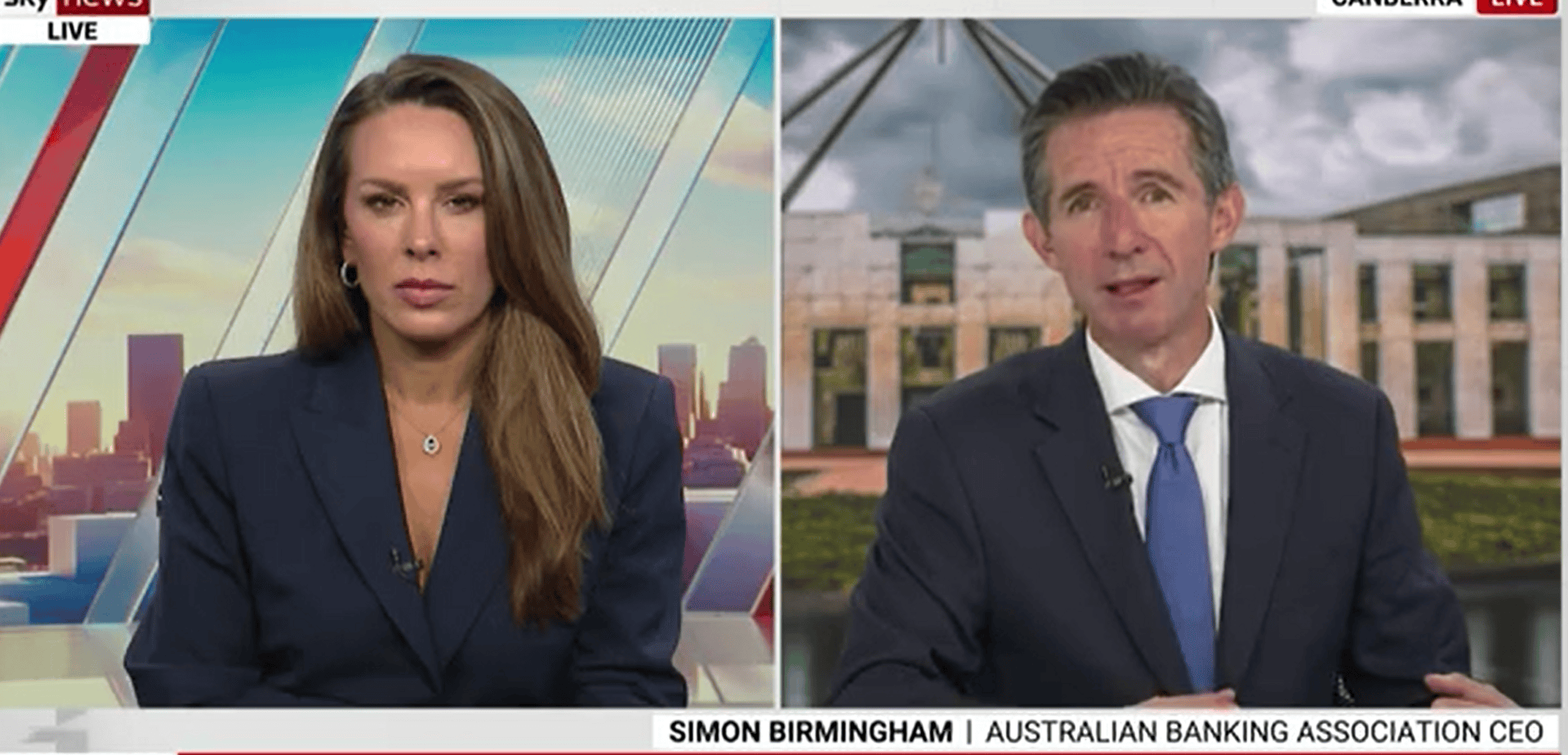
Sky News Afternoon Agenda
1 April 2026.
Topics: hardship support from banks; RBA decision on surcharging and interchange.
Laura Jayes: I want to bring it back to the situation we find ourselves in economically now. A lot of you are hurting. Petrol prices are pushing up really the cost of everything. Joining me now is the Australian Banking Association, CEO Simon Birmingham, Birmo thanks so much for your time. The banks say that will help those who are struggling right now, how and for how long?
Simon Birmingham: Well, thanks. LJ, it’s good to be with you. So, there’s a lot of resilience in households and businesses across the Australian economy at present, but there are also absolutely those who are doing it tough too. And our key message that we’re launching through a new campaign at present is ‘don’t tough it out on your own’. Get in touch with your bank if you are in difficulty. Now, because this is a different crisis to those that have gone before, the responses need to be different, and they really need to be personalised to those small businesses, farmers, transport and logistics operators those perhaps in construction being impacted by supply side shocks, as to how you tailor assistance to them, which could be working capital relief, it could be refinancing different bank terms and obligations, or in terms of households, in terms of potentially extension of loan periods, or in extreme cases, looking at deferral of payments or the like. And all of those things are about providing bespoke, careful, targeted responses, and banks are used to doing that in terms of crises, natural disasters, droughts, floods, fires, as well as nationwide crises. And really the message today is get in touch, banks are scaling up their hardship support teams. They’re making sure they’ve got people skilled in those particular areas of the economy being hit at present to be able to respond in targeted ways.
Laura Jayes: So, this is available to everyone you mentioned, households there, but also those crucial businesses that are affected right now. But I think what you’re also telling us Birmo, is it’s not COVID era kind of relief, but it is case by case, and if you need to in extreme cases, defer a payment for your home loan or you need to go back to interest only you can do that without there being a red flag on your account.
Simon Birmingham: So every crisis is different, and I said this indeed, is different from those that have gone before. The COVID and Pandemic era shocks were big demand side shocks to the economy. Right now, we’re facing supply side shocks through the increase in fuel and shocks in the availability of certain fuel related products or liquid fuel based products. And so they are very different, and it’s important that responses, be they from government or from business and industry, don’t take those supply side shocks and make them worse by creating other demand side shocks, by steering people away from normal economic activity where they can, but yes, for those who cannot, for those who are absolutely struggling or feeling real pressures in their small business or in their household at present, get in touch with your bank. The hardship team contact details are available on the Australian Banking Associations Financial Assistance Hub, which we’ve relaunched today, and that can provide you with direct contact points into your bank to talk about your special circumstances.
Laura Jayes: Can we talk about the RBA banning credit and debit card surcharges yesterday? What is this actually done in practice? In terms of distribution of costs.
Simon Birmingham: So the surcharge ban, I think we all find surcharging to be quite an irritating practice, and as a banking industry, we’ve got no complaints with seeing an end to surcharging, which was often unfairly blamed on banks when they were actually decisions taken by retailers, but the RBA also made a series of other decisions yesterday, including cutting what’s called interchange fees. Now interchange is one part of what merchants, retailers and businesses pay when you are paying by card, and there are costs attached to every different payment type. This is one part of when you’re using a card to pay in a transaction. Now they’re cutting it to lowest levels in the world, indeed, lower than many comparable economies. And why does that matter? Because it’s those fees that Australian banks use to build the payment system that enables that money to flow seamlessly from your account to pay that business to their account to pay another business, all of the things that happen in the background that we take for granted. And banks spent more than $2 billion building the payment system that’s on top of more than $2 billion spent annually maintaining protections against fraud and scams and other things. And by cutting them as deeply as they have, it’s going to undermine the sovereign capability of banks to keep doing so, and what we’re really critical of is that this decision does nothing to change the increasing share of revenue that Apple, Amex, as big multinationals are taking out of the payment system, but it leaves Australian banks with less to be able to invest in keeping that critical. Infrastructure going and really starts to threaten, potentially, the sovereign capability to invest in that.
Laura Jayes: Right, so your complaint here is actually, who the biggest beneficiary of this change is? It doesn’t seem to be Australian banks or Australian institutions. Is it right that of that 0.3%.. 0.3 interchange fee – many people use AmEx, many people use Apple. Apple, for example, 50% of that goes to Apple. The banks have to pay for that. So you’re saying, basically, this is kneecaped Australian banks. It’s given international competitors like Apple and AmEx, a leg up.
Simon Birmingham: That is the real concern, that precisely in terms of you’ve described it, 15 basis points or point one-five per cent of transactions using your Apple device are reportedly going straight through to the pockets of Apple into the foreign multinational, leaving only up to the same 15 basis points, or point one-five percent going into Australian banks to maintain the infrastructure. Apple is not paying for the infrastructure. They barely pay tax in Australia. You’ve got a situation where the largest banks in Australia paid more than $16 tax last year…
Laura Jays: But surely the RBA knew this? And they did this anyway?
Simon Birmingham: So in fairness to the RBA, they only gained some of the legal powers to look at those multinationals like Apple and AmEx partway through the review they were doing. Now we would have rather they changed course when they got those powers and actually used them in a comprehensive way, but having not done that and done it in a fragmented way, the message now is that it is more important and urgent than ever for them to undertake a comprehensive review of the payment system and look at, indeed, how they ensure fairness when it comes to those who are not contributing in the Australian economy and not contributing their taxes in Australia in the same way that Australian banks do. Don’t think anybody supports a better deal for banks, but we do look to ensure there’s a fair deal, and one where those Australian banks can keep investing in Australian infrastructure and not leave it completely dependent upon overseas interests.
Laura Jayes: Birmo, we get the headline, you know, $1 billion or $1.6 billion in savings. But who actually gets that money? Are consumer going to pay less because of this? Are small business is going to be better off?
Simon Birmingham: Where banks and many small businesses aligned in their concerns put to the RBA through this process was that international experience shows if you cut surcharging, sorry, if you cut interchange in the way the ABA is proposing other parts of the fee cycle, those imposed, potentially by the card schemes like MasterCard or Visa card, or by some of the technology providers like Square that people increasingly see out there, will simply soak up the difference. So there’s a real risk that merchants, retailers, small businesses across Australia don’t see any benefit from the cut to what banks might be getting, but it indeed flows again into pockets of foreign multinationals and of course, those small businesses will have to make decisions about their pricing just as banks will have to decide on their pricing.
Laura Jayes: Yeah. Well, that’s a that’s a good point, because we talked about small business, we talked about consumers. What about big retailers like Coles and Woolworths, they’re going to lose out as well, aren’t they? They can’t and won’t absorb it. So we can expect that they are going to recover costs elsewhere.
Simon Birmingham: Well, banks will have to have a look at, potentially, how they change fee structures for those very large businesses, as well as precisely as the RBA indicated would happen, banks will have to look, in their individual circumstances, at credit card fees, charges, interest free periods, all of those things that are embedded as part of the credit card landscape. And potentially those changes may be detrimental to some consumers. It’s not what banks want to do, but ultimately, they’ve got to be able to recover the cost of operating and maintaining that payment system, which falls squarely on the shoulders of banks, whilst others like Apple and Amex simply take advantage of it and largely ride for free.
Laura Jays: Are you breaking out into hives being back in Canberra, or are you happy to be there because your natural environment.
Simon Birmingham: It’s a slightly surreal day. I’m getting to talk to you again, being in your Canberra studio let alone stepping up in the Blue Room, which I thought was well behind me. But they’re unpredictable times LJ.
Laura Jayes: Yes, they certainly are. Simon Birmingham, thank you. Appreciate your time.
Simon Birmingham: Pleasure.
Ends
Latest news
E&OETV InterviewInterview on News24 AM Agenda1 October 2026 Topics: Card surcharging ban; Interest rates; Refinancing Laura Jayes: Well credit card, any card surcharges are banned from today. I know customers will be happy. Small business, though, they’re not so sure. Joining me live now is the Australian Banking Association Chief Executive, Simon Birmingham. Simon, great… Read more »
E&OERadio InterviewInterview on FiveAA Adelaide1 October 2026 Topics: Card surcharging ban Stacey Lee: Well, speaking of budgets, everyone’s are tight at the moment and they might get a little bit tighter from today because card surcharges have come to an end. It’s the first of October. It’s a deadline on a whole lot of things,… Read more »
E&OERadio InterviewInterview on ABC Adelaide1 October 2026 Topics: Interest rates; Hardship support from banks; Card surcharging ban Sonya Feldhoff: Simon Birmingham is the CEO of the Australian Banking Association. He’s also a former SA senator and finance minister. So, all of these things have been very much in his purview for a long time. Simon… Read more »