
29 July 2026
E&OE
TV Interview
ABC News
29 July 2026.
Topics: ASIC report into offset accounts
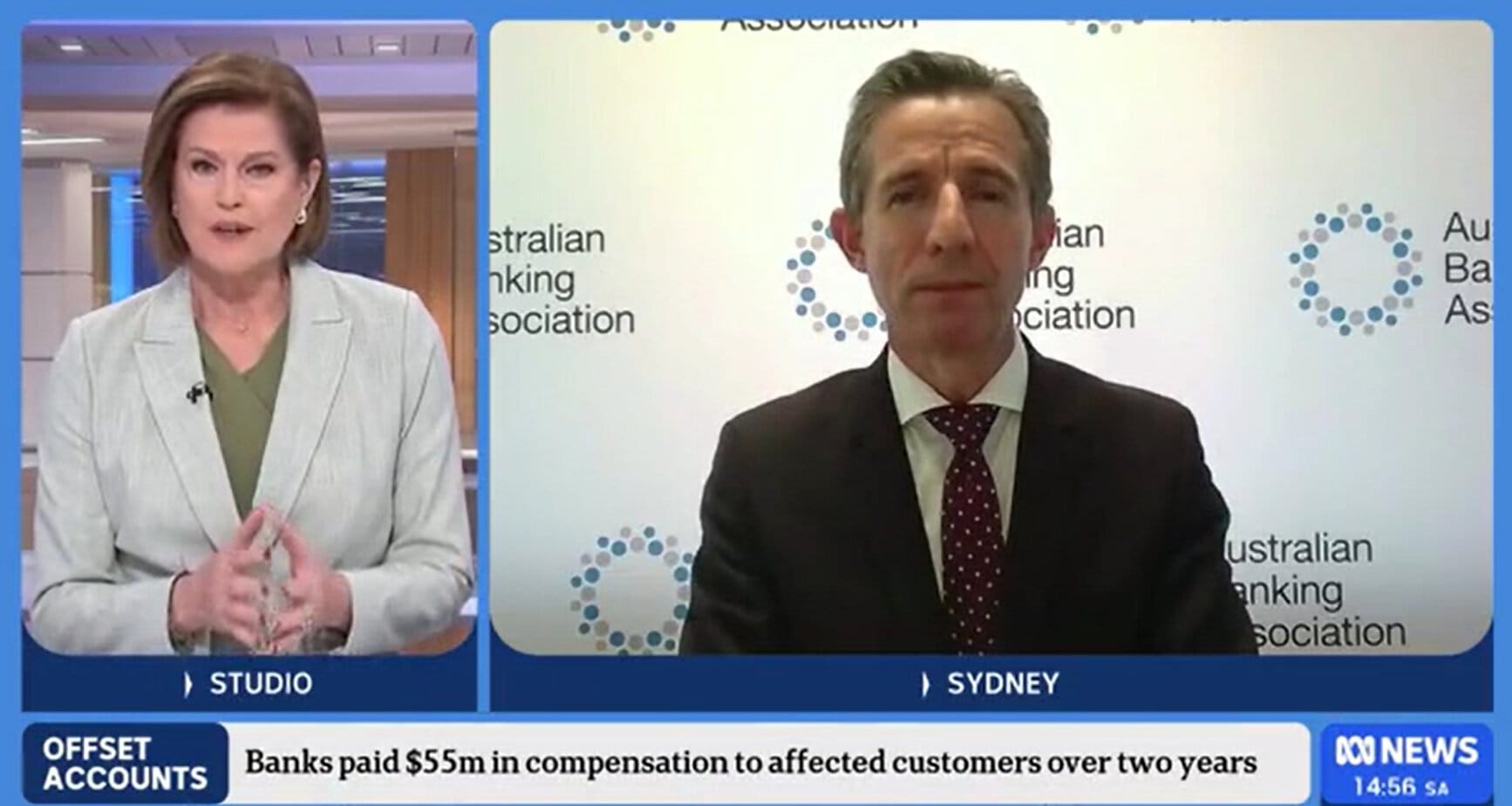
Ros Childs: Borrowers are being advised to check if they have paid more interest than they should following an ASIC review. The two-year review conducted by the corporate watchdog has found weaknesses in how eight banks monitored and managed offset accounts, resulting in borrowers missing out on promised savings. The CEO of the Australian Banking Association, Simon Birmingham, says the report shows offset accounts do work for most borrowers.
Simon Birmingham: Well, we see ASIC’s work as being very important, and as a banking industry, we recognise it is a critical part of a system that seeks to get things right for banking customers as close to 100 per cent of the time as is possible, but it’s important we have different checks and balances to identify when things do go wrong. Now, this report into mortgage offset accounts, the first thing to really reassure Australians of is that it’s demonstrated that in well over 99 per cent of cases, mortgage offset accounts are working exactly as they should. But it has also called out a number of instances where banks needed to act, where there had been manual processes or communications failures that aren’t acceptable, that did need to be rectified. Banks taking the steps to rectify them for customers, to compensate any customers, but also critically to learn best practice from one another, and another thing that asset report does is it calls out some of the best practice in some banks, so that others are able to better learn from that.
Ros Childs: So, you say that the issue is only affecting 1 per cent of Australians, but $55 million in remediation has already been paid out to hundreds of thousands of borrowers. That is a significant number of people.
Simon Birmingham: It’s a big number, although to put it in perspective, the size of offset account holdings across Australia is nearly $350 billion. So, it’s actually a very tiny fraction of that total holding in terms of offset accounts, but yes, it’s a compensation that is rightly paid to customers where failings have been identified. Those failings shouldn’t occur, and banks absolutely aspire, as I say, to try to get it right 100 per cent of the time of the time. This report looked at around 204 000 different loans and mortgage offset accounts, and ASIC found problems in just hundreds of cases. So, it’s ASIC’s data demonstrating that in well over 99% of occasions the system appears to be working as it should. But in those small numbers, there are lessons to learn, and I know the banking industry is committed to learning those lessons. And one of the helpful things ASIC has done in its report is to identify where they see better practice in some banks, to call out that best practice, and therefore that will no doubt form part of the way banks who have seen some failings respond to that, ensure they don’t happen again.
Ros Childs: But ASIC found that in some cases failures went undetected by the banks until they started asking questions, that’s a big concern for customers. So, is the banking sector now reviewing its practices with offset accounts, given the problems, to learn those lessons?
Simon Birmingham: Well, Ros, that is indeed why, right at the outset, when you asked about the report, I welcomed it, and we welcomed the checks and balances that exist. Ideally, nothing goes wrong any of the time. But of course, we live in a world where manual systems, other communications gaps, can create problems occasionally. When those problems occur, again, ideally, the banks themselves identify and rectify it. Many of these problems were self-reported by banks. However, we have the additional check and balance, which is precisely what a what a regulator like ASIC does: is to look at these types of issues and to ensure that there is an identification of them and steps taken to rectify. And so, the system really working as it should, seeing a small number of failings, still calling them out and making sure that banks rectify them for individual consumers and change their practices so they don’t occur again.
Ros Childs: Small number of findings or issues rather but involving a lot of money. And part of the issue is that offset mortgages are complicated, aren’t they? Customers very often don’t fully understand the figures and rely on their bank to get it right. So these ASIC findings really do not confidence in banks for customers.
Simon Birmingham: So most people should absolutely have confidence. The findings of only a few 100 cases out of more than 200 000 reviewed should give people confidence. And offset accounts are an incredibly important part of the way Australians innovatively use their financial system. Not all countries have the type of offset arrangements that Australia does, and certainly not all use to the scale that they do in Australia. Offset account holdings have grown by some 28 per cent just in the last two years. To that, nearly 350 billion dollar figure, and on a day when people are talking about inflation and interest rate considerations, it is more important than ever. Now, a simple thing that it absolutely would encourage customers to do is just to check your bank statements, make sure that you’re seeing changes to the interest you’re paying when there is more or less in your offset account, it’s a very simple way of understanding what is happening.
But banks absolutely know the buck stops with them. The responsibility is on them to get it right. Overwhelmingly, they are doing so. But this report gives some signals for where practices can improve, such as when people change their loan arrangements, that banks need to be more proactive in terms of giving those customers information about what those changes means for how their offset account works, and ensuring customers are empowered then to make sensible decisions about keeping that offset linked, and if so, to which part of their loan if they’ve made those changes.
Ros Childs: Simon Birmingham, you were a very senior member of the Liberal Party for a long time. You were in the federal parliament for nearly 20 years. You’ve been out of politics for a year. What do you make of the current political landscape?
Simon Birmingham: Look, right around the democratic world, we are seeing a fracturing in global politics, I’m not out here being a political commentator anymore. But that fracturing is not unique to Australia. You can see it occurring across Europe, in the UK, elsewhere, and that puts real pressure on governments. And it’s occurred at a time where people have felt inflationary pressures, sometimes real inflationary pressures for the first time in in their working or their lives overall, and so understand what some of the drivers here are. What is critical is how parties and governments respond with good policy and policies that are about creating economic growth that can generate sustainable wages growth, productivity growth, the types of things that can see then real wages growth over time and get people back to a sense of having the type of confidence that clearly is lacking in too many household budgets at present.
Ros Childs: Simon Birmingham, thank you.
Simon Birmingham: Thank you, my pleasure.
Ends
Latest news
We write on behalf of the undersigned Alliance of Industry Associations to raise a growing concern aboutgovernment’s inadequate consultation on recent complex legislative and regulatory reforms. We represent 30groups from across the economy including small, medium and large businesses, farmers, builders, retailers,universities and tax and accounting professionals. Our organisations support genuine and timely consultation as… Read more »
The ABA welcomes the release of the Federal Government’s response to the Parliamentary Joint Committee on Corporations and Financial Services’ inquiry into financial abuse, released today. ABA CEO Simon Birmingham acknowledged the important work of the committee as well as the Government’s response and said banks were committed to protecting customers from the scourge of… Read more »
E&OERadio InterviewInterview ABC Statewide Drive Victoria9 October 2026 Topics: Regional banking Jane Nield: Well, do you still have a bank branch in your local area? If you’re one of the more than 600 regional locations nationwide that have lost a bank in the last few years, did it have a big impact? So often, it… Read more »