
31 March 2026
E&OE
TV Interview
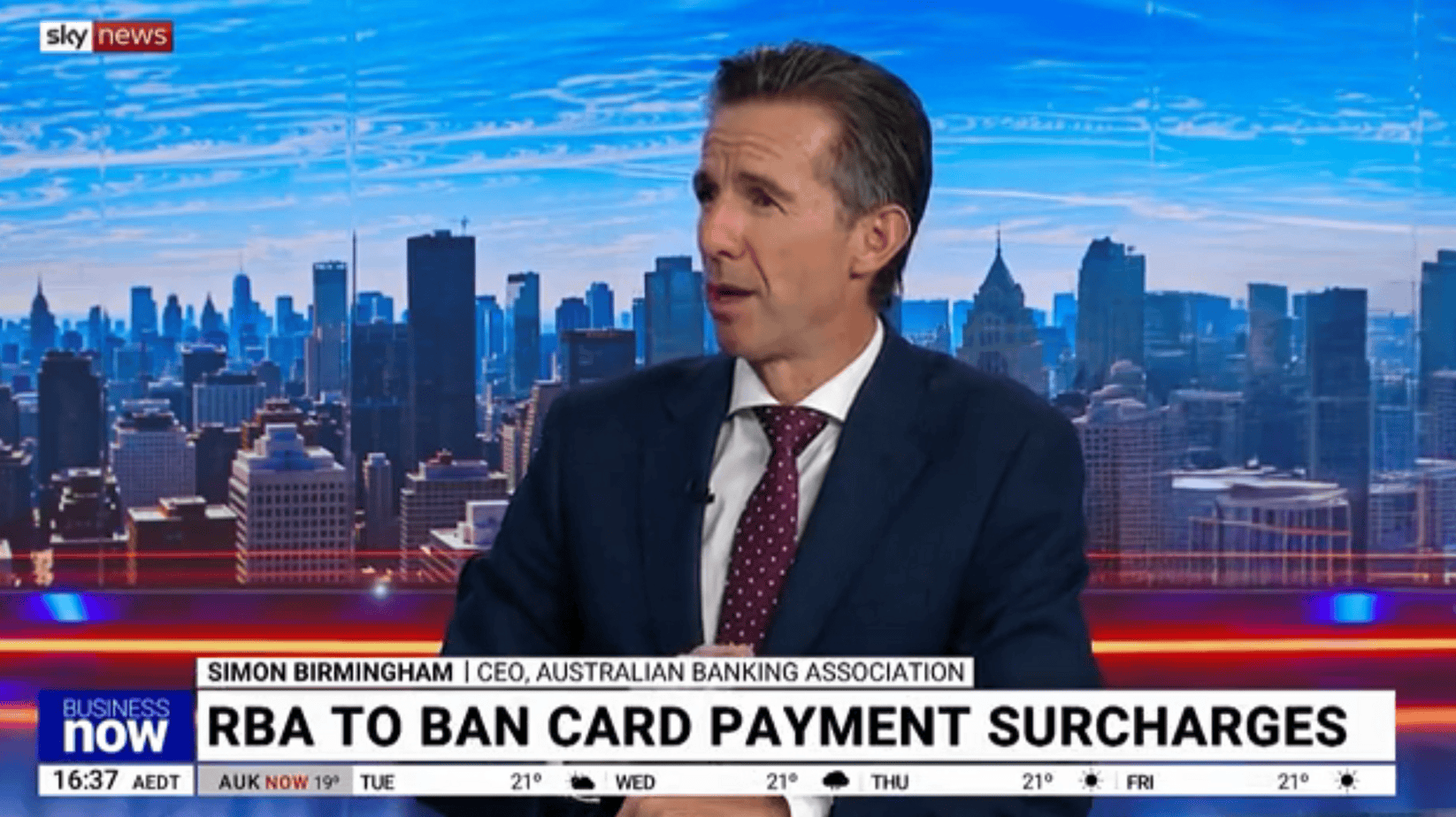
Sky News Business with Ross Greenwood
31 March 2026.
Topics: RBA decision on surcharging and interchange.
Ross Greenwood (Host): Chief Executive of the Australian Banking Association, Simon, thanks for your time. You’re not happy, are you?
Simon Birmingham (Guest): No, Ross, we’re not. Look we understand why many Australians find surcharging to be a bugbear, and everyone will be happy to see the back of it from a consumer perspective and indeed, banks often unfairly cop the blame for it. But there are real consequences from the other decisions the RBA has taken today. Australia’s banks spent more than $2 billion building the infrastructure that is our payment system, and they fund that as well as more than $2 billion a year in investment in fighting financial crime and other things out of things like interchange. It operates in the background, it’s only one part of the structure that is paid in relation to payments, but it’s the path that is essential for banks to keep investing in that system. And it’s not paid by your Apple’s or your Amex’s, and those who are taking and will now continue to take an even greater share of the payment system, because they’re untouched by today’s decision, whereas Australian banks find that they are taking a big cut out of it.
Ross Greenwood: Okay, so what you’re saying is, effectively, as a result of this, more people using Apple Pay, Google Pay, Samsung Pay, means that ultimately those big tech companies take a bigger share of payments in the future, without paying for the existing infrastructure that’s in place for Australia.
Simon Birmingham: So, some of the reports are that Apple Pay charges up to 15 basis points on transactions through that tap and go mechanism.
Ross Greenwood: So, point one five of a percent.
Simon Birmingham: Point one five. The RBA is today imposing a cap on what banks can charge of point three or 30 basis points. So that means that half of what is being paid could well be going straight out of the country, off to Apple, and we know that they pay around $156 million in tax last year, whereas Australia’s largest banks paid $16 billion in tax last year. So, we have a situation where the sovereignty of Australia’s payment system could be eroded over time, if those banks who are expected to fund it and pay for it can no longer extract the funds to maintain it out of that payment system, while they see more and more of that revenue drive offshore.
Ross Greenwood: Okay, one thing that the Treasurer said was that getting rid of this is a win for consumers, $1.6 billion is the headline number they’ve come up with. But to my thinking, if those prices are simply absorbed by raising the price of goods and services, there’s not the real saving out there that’s imagined?
Simon Birmingham: We can understand and indeed sympathise with the concerns of some of the small business groups too, because the international experience is that when interchange fees are cut, other fees end up going up elsewhere in the system, not necessarily bank fees, but card schemes, acquires other parts, as I said before, those interchange are just one part of what merchants, what retailers get charged as part of transacting. It should also be remembered that every payment comes with a cost. Cash is not free to handle, small businesses have to put extra security in to handle cash. It takes more time to handle cash, you don’t get the automatic reconciliation. So all of these things ought to be factored and our concern that fundamentally is today’s decision weakens Australia’s sovereignty in the future, because it undermines the capacity of Australian banks paying taxes in Australia, employing Australians to keep investing in that Australian infrastructure, while we will see those foreign multinationals taking a greater share of that revenue in the future.
Ross Greenwood: But it is also true that Mastercard and Visa, are US multinational companies that operate here. The one thing that is a big question mark is the EFTPOS service that Australians know that Australian banks invest in. That’s the key here, isn’t it?
Simon Birmingham: Well, yeah, we do see more and more Australians use debit cards now, many of them, of course, through Visa or the Mastercard platform too. But the opportunity does sit there in terms of EFTPOS, which has lost some of its market share from where it was many years ago. There are reforms we’d like to see in the future in terms of the way in which government and the Reserve Bank regulate those foreign multinationals to use new powers the Reserve Bank has, and they’ve indicated they will start that process. Today’s decision makes it more urgent for the Reserve Bank to do that review, capturing your Amex’s, your Apple’s, and those foreign multinationals faster, sooner, comprehensively. So, we’ve got a fair system in the future, not one that is only regulating the Australian part and not dealing with the growing international part.
Ross Greenwood: Simon Birmingham, always good to get you on the program and thanks for your time today.
Simon Birmingham: Thanks Ross, my pleasure.
Ends
Latest news
Banks welcome Treasurer Jim Chalmers’ release today of draft regulations to lift the cap on covered bond issuance, a practical step that would help small and mid-tier banks access cheaper, more stable funding. ABA CEO Simon Birmingham said these changes, including streamlined reporting for smaller banks, are a welcome part of the Government’s broader productivity… Read more »
Banks have welcomed Shadow Treasurer Tim Wilson’s call today for the Australian Prudential Regulation Authority (APRA) and the Australian Securities and Investments Commission (ASIC) to give more weight to economic growth in their decision making. ABA CEO Simon Birmingham said regulation that supports growth is key to lifting productivity across the economy. “Banks want to… Read more »
E&OETV InterviewInterview ABC Afternoon Briefing19 October 2026 Topics: Australia-EU free trade deal, investment benefits Patricia Karvelas: Simon Birmingham is the CEO of the Australian Banking Association, but he’s a former finance minister in a previous coalition government. And our guest, welcome to the program. Simon Birmingham: Hi, Patricia. Good to be with you again. Patricia… Read more »