
20 April 2026
Speakers:
Australian Retail Council (ARC) Chief Executive Officer Chris Rodwell
Business Council of Australia (BCA) Chief Executive Bran Black
Council of Small Business Organisations Australia (COSBOA) Director Wes Lambert
National Farmers’ Federation (NFF) Chief Executive Officer Mike Guerin
Australian Banking Association (ABA) Chief Executive Officer Simon Birmingham
E&OE
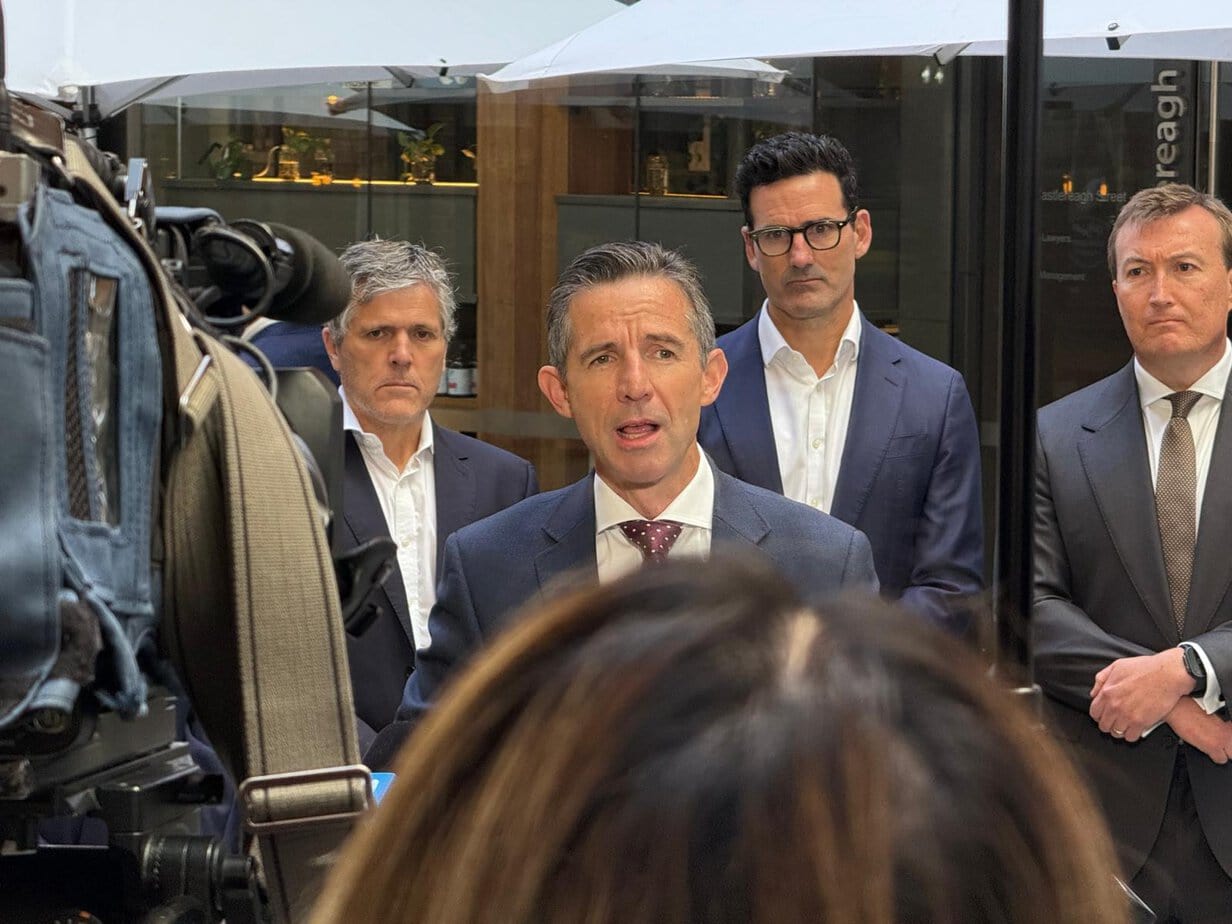
Bran Black, BCA: Well, I’m here with colleagues from farming, from small business, from retail, but most importantly, we’re here at Pablo & Rusty’s in Sydney, and we really thank them for their hospitality. This morning, we’ve got a very clear and simple message: Australia is addicted to red tape, and it is well past time we got off the juice.
We’re seeing that there are extraordinary costs that businesses are incurring right across the economy, and it doesn’t matter if you’re in farming or in retail or in small business, you’re seeing those challenges.
We are part of an Alliance of 27 industry associations, and we’ve come together to make calls for what we regard as being the best economic interests of Australia, not just now, but for the long term. And what we’re arguing for today is a cost reduction in the burden of red tape by 25 per cent.
We’re seeing that the costs incurred by businesses right now are extreme. The AICD, one of our Alliance members, has put the cost of red tape at $160 billion each and every year. That’s up from 65 billion in 2014 and it now represents a staggering six per cent of GDP.
It is wrong that you need 37 different licences in order to pour a cup of coffee in Victoria, or 25 to do the same thing here in New South Wales. It is wrong that a tradie in Coolangatta needs a separate license in order to fix a tap just across the border in the Tweed. It is wrong that we have 36 different categories of payment in our payroll tax systems, with only 10 that overlap across different states and jurisdictions. It’s wrong that we have 15 different definitions of small business. It’s wrong that we don’t have a nationally consistent approach to workers’ compensation or a nationally consistent approach to long service leave.
These are all burdens that businesses feel each and every day, and what I’ve just heard from Pablo & Rusty’s is that the best thing that government can do is get out of the way as much as possible so that businesses can get on with the job of doing business.
Now we’ve seen that other countries are taking important steps in this regard. The United Kingdom has put in place a target to reduce the burden of red tape by 25 per cent, the European Union has done the same. We’re seeing in Canada and in the United States that they are also committed and making some tangible steps forward. We need to do the same thing.
And the time is right. We know in a world of turmoil and uncertainty around us, as we see day to day, particularly with challenges coming out of the Middle East. The best thing that we can do is set ourselves up for the future by being as strong as possible, by putting our best foot forward, by attracting investment here at home, but also investment from abroad and we do that by having quality regulatory settings.
So now more than ever, the steps that we can take to keep a lid on red tape, to make sure that we don’t see it get out of control, are so very important. So I reiterate once again, we are calling for a reduction in the cost burden of red tape by 25 per cent. We see that Government is taking some steps in this regard. We welcome the opportunity to work with Government ahead of the Budget, and we look forward to making sure that we can take some pressure off business. At the end of the day, you get what you measure.
Wes Lambert, COSBOA: So I come here today representing wearing two hats as a representative of COSBOA, but also as the CEO of ARCA, Australian Restaurant & Cafe Association. Small businesses are drowning in red tape. The Government says things are getting better, but actually, when you speak to small businesses around the country, they just tell us that things are getting worse and worse because we have overlapping local, state and federal regulations that are costing Australian small businesses and businesses in general $160 billion a year.
This is why we’re calling for a 25 per cent reduction in that cost so that we can put that money back into the hands of small businesses around the country, so that they can invest in productivity, invest in AI, invest in solutions to make their businesses better and to increase the profitability of their businesses. Ultimately, this is what will lead to improved productivity.
Now we’ve just finished at a cafe that said that in New South Wales, there’s 25 regulations and permits they have to abide by just to open their doors. We know in Victoria, it’s 37 permits and regulations that have to be completed in order to operate your hospitality business. This is not good enough, so we’re calling upon the Government to pay attention to small business and reduce red tape.
Mike Guerin, NFF: Farmers and producers stand with broader industry in seeking a significant and immediate reduction in red tape. If we want to keep that food security we’ve taken for granted for generations going, keep our supermarkets full of locally grown fresh produce every day of the week, every year, we need an urgent reduction in red tape. An urgent reduction in the duplication that is in place between local, state and federal laws.
Producers right now have had a doubling in input costs of fuel and fertiliser through the winter planting. They are losing money by planting crops to keep our supermarkets full of fresh and locally grown produce. Without an urgent reduction in red tape and the productivity improvements that come from it, we face an industry that may no longer be able to offer that food security.
Young families and regional communities who can no longer pay the mortgage, young producers who no longer take on the game of farming for the next 40 years, commit to buying that land and commit to underpinning the industry that we’ve taken for granted for so long.
So we stand beside broader industry in saying agriculture has a tremendously powerful and positive part to play. It needs an urgent reduction in red tape to build that productivity and to give us confidence to continue to grow that food.
Chris Rodwell, ARC: We are deeply supportive of a 25 per cent reduction in red tape by 2030. Our own research shows that the cost of states having different approaches to regulation, different rules, costs households $9.4 billion over the next 10 years. The cost to national GDP is $26 billion. It is time to act.
It is too much for retailers to be working across different states with different rules. Whether it comes to transport and logistics or whether it comes to sustainability and the environment, there are different rules, and retailers deserve one set of rules. It is critical that in the upcoming Budget, in just over three weeks, that the Federal Government has a plan to reduce red tape, and that plan has to be a commitment to a 25 per cent reduction by 2030.
Simon Birmingham, ABA: Less red tape equals more jobs for Australians, lower costs for Australians, and a more resilient Australia. And that’s why we want to see cuts to red tape in this Budget, commitment from governments right across the country to reduce red tape so that we get that stronger Australia, more jobs for Australians and lower costs for Australia. That’s ultimately what’s necessary.
International benchmarks show time and again that Australia has been becoming less competitive, and the Treasurer and the Government have been absolutely right to put productivity front and centre of their ambitions in this term. This Budget is about delivering on those ambitions. We welcome the indications, want to see the action so that Australia can see the benefits that will come from red tape reduction.
Journalist: The Federal Government has said that this Budget will be committed to slashing clients’ costs and red tape as well. That 25 per cent threshold, have you had conversations with the Government? Do you know if they’re receptive to that offer?
Bran: Yes, we have spoken with the Government in length in terms of the type of changes that we’d like to see and the target that we’d like to see set. We know that Government is looking at having a Budget that, at least in part, is focused on what it can do to make reductions to red tape, and that will be, of course, of great support and assistance to business.
But we do urge having a target, because at the end of the day, you get what you measure. And the important thing here is that we take those important steps to put in place, A, the target, and then B, the work that’s needed now, but also into the future, to make sure we can deliver on that target.
Journalist: When you talk about those stacked regulations [indistinct]. Why is that issue now being addressed? Is it due to the economic situation, or is this something that your members have been raising for decades or years?
Bran: The calls that we’re making are calls that we’ve been making for some time now. But I think the importance of what we’re arguing for, particularly in having a target and putting in place measures to help us get there, has only been exacerbated by the challenges that we’re seeing emanating from the Middle East.
I mentioned before that in circumstances of change and turmoil, the best thing Australia can do is control the things that are within its scope to control. That includes having the best possible settings so that we can attract investment, both investment from people who are looking to do business in Australia, who are already here, but also business and investment from people who are outside Australia and looking at places in which to invest their capital. We hope that by having quality regulatory settings in Australia, we can make sure we secure as much of that pool as possible, and that we grow the pie for the benefit of all Australians.
Journalist: In terms of the three levels of government that we have in this country, which breeds it’s own problems, which is the hardest to shift in terms of the red tape you’re talking about? This café I imagine has a bunch of red tape from Sydney Council.
Bran: It’s a great question, because I don’t think you can say, unfortunately, that there’s one layer that’s any worse than the other. The reality is that we’ve just got too much right across the board. If you look at major projects, for instance, at a federal level, you still need a state approval and a federal approval in order to be able to move forward, and that adds an enormous amount of time and costs.
At a comparison, we see that in Canada, they’ve recently made the call that if you get a provincial approval, which is their equivalent of a state, if you have a provincial approval, then you don’t need a federal approval. That’s a challenge at the federal level. We see at state levels all number of different challenges, be it with respect to compliance with payroll tax or in terms of, as I mentioned before, the different arrangements that we have in place for workers’ compensation or long service leave.
One thing that we’ve been arguing for which we think would make a big difference, is additional funds for the National Productivity Fund. The Federal Government’s put that fund in place, and that is an excellent measure, but what we’d love to see is more funding and more resource made available to that particular initiative, which helps states take the really difficult steps towards hard to reach reforms that often take a bit of cost.
Journalist: Does it ultimately mean, and logically mean, that we need to shift more things federally than what they currently are?
Bran: I think we do need to make federal changes, there’s no two ways around that. I mentioned before, with respect to the EPBC, that that’s a great example of regulation that we need to see streamlined. By the same token, we’ve got concerns with respect to industrial relations, which impact on the way in which business is done day to day.
There are steps the Federal Government can take, but there are also steps that states can take, there are steps that local governments can take, and there are steps that the federal government can take that support those other layers of government to do their own work as well. So it’s really an effort that we want to see across the board.
And I do stress when we talk about that target of having a 25 per cent cut in the cost of regulation, we’re not just asking the federal government to put that in place. We’re saying we want to see every state and territory put in place its own commitment to reduce the cost of regulation by 25 per cent. It’s a commitment that needs to be seen right across the board.
Journalist: How receptive are the regulators themselves to a 25 per cent cut in red tape?
Bran: I think that’s a really important question. We know that the Government has written to the regulators and indicated that they want to see some changes with respect to their approach to regulation, but we just do need all parts of government, from the regulators to government departments at different levels, to all step up and to genuinely be engaged in the process of thinking through “Do we need to do this? And if so, are we doing it in the best possible way? Is there a different approach that we could take that would ultimately deliver for businesses a better approach to their own management of risk and their own management of their finances?”
Journalist: So why now [indistinct]? We’re three weeks away from the Budget.
Bran: The reason why we’re making this call right now is that we are in the stages of course of considering what the Budget is going to bring, and so now is the time for us to be really pushing this point. And we are doing this, of course, here in public, but we’re doing it behind closed doors in Canberra as well, and talking directly with ministers and directly with staff, and making sure that people understand where we see the opportunities for these types of changes to be made.
This isn’t just an empty call that’s devoid of specific examples. To the contrary, we’ve put forward the specifics. We’re clear in terms of the steps that need to be taken in order to be able to get this type of process moving, we want to see it moving, and we think that now is a great time to take it forward.
Journalist: Just on other matters, capital gains, tax, from a business perspective, what’s your take on where we seem to be headed with this?
Bran: From a Business Council perspective on CGT, we’ve always been very clear that we will want to see holistic, broad tax reform. That’s ultimately what we think success looks like. If, however, there is to be change with respect to CGT, we think that needs to be subject to a couple of core preconditions.
In the first instance, it shouldn’t be retrospective, people have made investment choices, and they should be honoured. In the second place, we’ve got to make sure that in doing this type of work, we don’t disincentivise investment in new housing, and ideally, we should incentivise investment in new housing. And the final point that I would make is that we really need to make sure, if we do see change, that if there is any benefit that accrues to the Commonwealth that that goes directly into productivity enhancement or into reducing the tax burden that individuals face, and I’ll pass over my colleague as well.
Simon: We welcome very much the fact that the Treasurer is indicating a Budget focused on spending restraint and productivity, and any tax reform that is pursued in this Budget should be measured against how it contributes to that productivity. And productivity ultimately needs to see investment incentivised and encouraged alongside the type of red tape cuts that we’re talking about as well.
And so it really comes down to the detail as to how such tax reform is actually pursued. And I’m sure everybody will be looking carefully at the details there, but the direction of saying the focus is on productivity, on spending restraint, is very positive.
Journalist: And the approaches appears to be being taken from new homes?
Simon: Well, we’ll have to see what the detail actually is. I’ve sat there on different sides of Budgets and seen plenty of pre-Budget speculation, long since learned that it’s, it’s better to deal with what’s in the Budget rather than the speculation of what might be in the Budget.
But while I do have the microphone, I will just do one other thing, which is to acknowledge the commencement today of the Government’s Economic Resilience Program. These interest-free loans for businesses affected by the current fuel shocks reverberating across the economy.
Australia’s banks are very pleased to have stepped forward as a delivery partner for these interest-free loans for Australian businesses, providing loans at up to $5 million interest-free, with the support of Government, and we urge those businesses across the freight, logistics, plastics, manufacturing, other sectors impacted by the current crisis, to come forward, talk to their bank about the assistance that’s available through this program or other measures.
Journalist: In regards to those interest-free loans, particularly the transport industry, essential for farmers. We farmers have been calling for guarantees. Where are the farmers right now with what the government is providing?
Mike: Agriculture acknowledges the Government for all the work they’re doing with industry over the last few weeks and what’s a very difficult time. What’s critical is we continue to work closely together. So underwriting ships of fuel and ships of fertiliser has made a significant difference to grabbing on the spot market available product and bringing it to Australia. Dealing with the cost issues remains a real challenge.
For those who plant crops at the moment, we are losing money with the diesel and the fertiliser, and the costs there too. The fact that we have more certainty of supply through some of the underwriting activities and others is really welcome, but it’s the first step in many we need to take urgently if we’re going to protect food security and allow the regional communities and agriculture to continue to grow that food that we’ve taken for granted for generations.
Latest news
Banks welcome Treasurer Jim Chalmers’ release today of draft regulations to lift the cap on covered bond issuance, a practical step that would help small and mid-tier banks access cheaper, more stable funding. ABA CEO Simon Birmingham said these changes, including streamlined reporting for smaller banks, are a welcome part of the Government’s broader productivity… Read more »
Banks have welcomed Shadow Treasurer Tim Wilson’s call today for the Australian Prudential Regulation Authority (APRA) and the Australian Securities and Investments Commission (ASIC) to give more weight to economic growth in their decision making. ABA CEO Simon Birmingham said regulation that supports growth is key to lifting productivity across the economy. “Banks want to… Read more »
E&OETV InterviewInterview ABC Afternoon Briefing19 October 2026 Topics: Australia-EU free trade deal, investment benefits Patricia Karvelas: Simon Birmingham is the CEO of the Australian Banking Association, but he’s a former finance minister in a previous coalition government. And our guest, welcome to the program. Simon Birmingham: Hi, Patricia. Good to be with you again. Patricia… Read more »